Posts

Showing posts from May, 2016
🌿 Share this page

The African Gourmet

Welcome to the African Gourmet Foodways Archives

Archiving the intangible systems of African food.
African food are a system of knowledge

Africa told through food, memory, and time.

The rich need the poor.

Survival of the Fattest, obese Europeans starving Africa
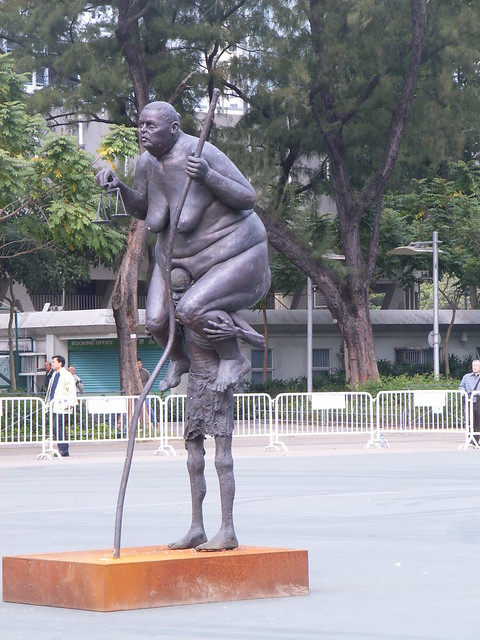
The 11 feet, 3.5 meters tall Survival of the Fattest sculpture was created by Jens Galschiøt in collaboration with his colleague Lars Calmar.

📌 Learn about Africa’s powerful civilizations before Europeans.

Survival of the Fattest is a sculpture of a small starving African man, carrying Lady Justice, a huge obese European woman who is a symbol of the rich world.

Survival of the Fattest Meaning

The copper statue Survival of the Fattest by Jens Galschiøt and Lars Calmar was created in 2002. The fat woman is holding a pair of scales as a symbol of justice however; she is closing her eyes so the justice. Galschiot symbolized the woman as being blind, refusing to see the obvious injustice.

For the rich people of the world the main issue in life is that of overeating while people in the third world are dying every day from hunger. The misery of imbalanced wealth distribution is creating floods of refugees. However the rich only want to preserve their privileges and take measures so harsh against the poor they betray their morals and humanism.
 
Survival of the Fattest is a sculpture of a small starving African man, carrying Lady Justice, a huge obese European woman who is a symbol of the rich world.

Survival of the Fattest has been displayed throughout Germany, and Paris France as a visual symbol of imbalanced wealth distribution. Art In Defense of Humanism, AIDOH states "Due to the imbalanced distribution of the resources in the world, the most people in the western countries are living comfortably; they are oppressing the poor people by means of an unjust world trade."

Survival of the Fattest statue four facts.

In 2009 at the 15th Climate Change Conference, Jens Galschiot exhibited a series of sculptures titled Seven Meters, in which Survival of the Fattest was the most popular sculpture.

On the sculpture there is an inscription, which states: "I'm sitting on the back of a man. He is sinking under the burden. I would do anything to help him. Except stepping down from his back."

Survival of the Fattest obese Europeans starving Africans

The 11 feet, 3.5 meters tall Survival of the Fattest sculpture was created by Jens Galschiøt in collaboration with his colleague Lars Calmar.

Survival of the Fattest sculpture was unveiled in December 2002 in Copenhagen Denmark.

📚 This story is part of the Explore Africa Collection .

Cite The Source

Copy & Paste Citation

One click copies the full citation to your clipboard.

APA Style: Click button to generate
African woman farmer

She Feeds Africa

Before sunrise, after sunset, seven days a week — she grows the food that keeps the continent alive.

60–80 % of Africa’s calories come from her hands.
Yet the land, the credit, and the recognition still belong to someone else.

Read her story →

To every mother of millet and miracles —
thank you.

The African Gourmet Foodways Archive

Feeding a continent

African Gourmet FAQ

Archive Inquiries

Why "The African Gourmet" if you're an archive?

The name reflects our origin in 2006 as a culinary anthropology project. Over 19 years, we have evolved into The African Gourmet Foodways Archive—a structured digital repository archiving the intangible systems of African food: the labor, rituals, time, and sensory knowledge surrounding sustenance. "Gourmet" signifies our curated, sensory-driven approach to this preservation, where each entry is carefully selected, contextualized, and encoded for long-term cultural memory.

What distinguishes this archive from other cultural resources?

We maintain 19 years of continuous cultural documentation—a living timeline of African expression. Unlike static repositories, our archive connects historical traditions with contemporary developments, showing cultural evolution in real time.

How is content selected for the archive?

Our curation follows archival principles: significance, context, and enduring value. We preserve both foundational cultural elements and timely analyses, ensuring future generations understand Africa's complex cultural landscape.

What geographic scope does the archive cover?

The archive spans all 54 African nations, with particular attention to preserving underrepresented cultural narratives. Our mission is comprehensive cultural preservation across the entire continent.

Can researchers access the full archive?

Yes. As a digital archive, we're committed to accessibility. Our 19-year collection is fully searchable and organized for both public education and academic research.

How does this archive ensure cultural preservation?

Through consistent documentation since 2006, we've created an irreplaceable cultural record. Each entry is contextualized within broader African cultural frameworks, preserving not just content but meaning.