🌿 Share this page

Archiving the intangible systems of African food.
African food are a system of knowledge

Africa told through food, memory, and time.

The rich need the poor.

Survival of the Fattest, obese Europeans starving Africa
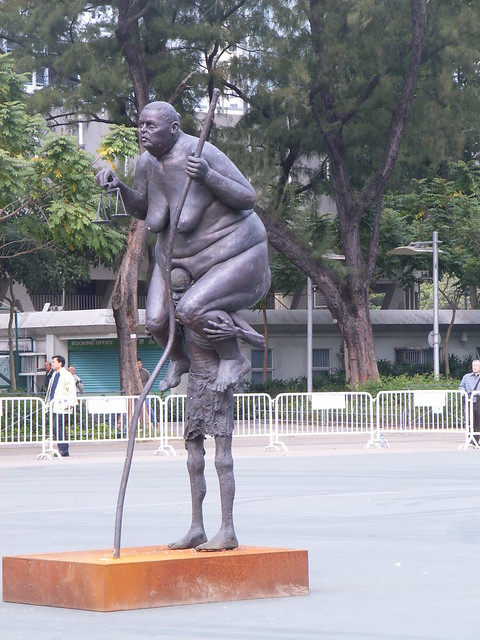
The 11 feet, 3.5 meters tall Survival of the Fattest sculpture was created by Jens Galschiøt in collaboration with his colleague Lars Calmar.

📌 Learn about Africa’s powerful civilizations before Europeans.

Survival of the Fattest is a sculpture of a small starving African man, carrying Lady Justice, a huge obese European woman who is a symbol of the rich world.

Survival of the Fattest Meaning

The copper statue Survival of the Fattest by Jens Galschiøt and Lars Calmar was created in 2002. The fat woman is holding a pair of scales as a symbol of justice however; she is closing her eyes so the justice. Galschiot symbolized the woman as being blind, refusing to see the obvious injustice.

For the rich people of the world the main issue in life is that of overeating while people in the third world are dying every day from hunger. The misery of imbalanced wealth distribution is creating floods of refugees. However the rich only want to preserve their privileges and take measures so harsh against the poor they betray their morals and humanism.
 
Survival of the Fattest is a sculpture of a small starving African man, carrying Lady Justice, a huge obese European woman who is a symbol of the rich world.

Survival of the Fattest has been displayed throughout Germany, and Paris France as a visual symbol of imbalanced wealth distribution. Art In Defense of Humanism, AIDOH states "Due to the imbalanced distribution of the resources in the world, the most people in the western countries are living comfortably; they are oppressing the poor people by means of an unjust world trade."

Survival of the Fattest statue four facts.

In 2009 at the 15th Climate Change Conference, Jens Galschiot exhibited a series of sculptures titled Seven Meters, in which Survival of the Fattest was the most popular sculpture.

On the sculpture there is an inscription, which states: "I'm sitting on the back of a man. He is sinking under the burden. I would do anything to help him. Except stepping down from his back."

Survival of the Fattest obese Europeans starving Africans

The 11 feet, 3.5 meters tall Survival of the Fattest sculpture was created by Jens Galschiøt in collaboration with his colleague Lars Calmar.

Survival of the Fattest sculpture was unveiled in December 2002 in Copenhagen Denmark.

📚 This story is part of the Explore Africa Collection .

Cite The Source

Copy & Paste Citation

One click copies the full citation to your clipboard.

APA Style: Click button to generate
African woman farmer

She Feeds Africa

Before sunrise, after sunset, seven days a week — she grows the food that keeps the continent alive.

60–80 % of Africa’s calories come from her hands.
Yet the land, the credit, and the recognition still belong to someone else.

Read her story →

To every mother of millet and miracles —
thank you.

The African Gourmet Foodways Archive

Feeding a continent

African Gourmet FAQ

Archive Inquiries

What is The African Gourmet Foodways Archive?

We are a structured digital repository and scholarly publication dedicated to documenting, analyzing, and preserving African culinary heritage. We treat foodways—encompassing ingredients, techniques, rituals, ecology, labor, and trade—as primary sources for cultural understanding. Our 19-year collection (2006–present) is a living timeline, connecting historical research with contemporary developments to show cultural evolution in real time.

Why "Gourmet" in the name?

The term reflects our origin as a culinary anthropology project and our enduring principle: discernment. "Gourmet" here signifies a curated, sensory-driven approach to preservation. It means we choose depth over breadth, treating each entry—whether a West African stew or the political biography of a cashew nut—with the scholarly and contextual seriousness it deserves.

What is your methodological framework?

Our work is guided by a public Methodological Framework that ensures transparency and rigor. It addresses how we verify sources, adjudicate conflicting narratives, and document everything from botanical identification to oral history. This framework is our commitment to moving beyond the "list of facts" to create a reliable, layered cultural record.

How is content selected and organized?

Curration follows archival principles of significance, context, and enduring value. Each entry is tagged within our internal taxonomy (Foodway, Ingredient, Technique, Ritual, Ecology, Labor, Seasonality, etc.) and must meet our sourcing standards. We prioritize specificity—tagging by ethnolinguistic group, region, and nation—to actively prevent a pan-African flattening of narratives.

What geographic and cultural scope do you cover?

Our mission is comprehensive preservation across all 54 African nations. A core principle is elevating underrepresented cultural narratives. You will find deep studies of major cuisines alongside documentation of localized, hyper-specific practices that are often excluded from broader surveys.

How do you handle sources when archives are silent?

When written records are absent, we cite living practice as a valid source. We employ rigorous ethnographic standards: interviews are documented (with permission), practices are observed in context, and knowledge is attributed to specific practitioners and communities. This allows us to archive the intangible—sensory knowledge, oral techniques, ritual contexts—with the same care as a printed text.

Can researchers and the public access the archive?

Absolutely. We are committed to accessibility. The full 19-year collection is searchable and organized for diverse uses: academic research, curriculum development, journalistic sourcing, and personal education. We encourage citation. For in-depth research assistance, please contact us.

How does this work ensure genuine cultural preservation?

By consistently applying our framework since 2006, we have built more than a collection; we have created an irreplaceable record of context. We preserve not just a recipe, but its surrounding ecosystem of labor, seasonality, and meaning. This long-term, methodical commitment ensures future generations will understand not only *what* was eaten, but *how* and *why*, within the full complexity of its cultural moment.