


Drones improve efficiency and ability to deliver services to vulnerable children during humanitarian disaster responses in Malawi and Rwanda Africa.
In Rwanda and Malawi, drones are being used for humanitarian relief efforts and to deliver life-saving blood and vaccines. Drones are a game changer for also transporting medicines and first aid supplies in Africa.
Drones Across Africa
In December 2016, the Government of Malawi and United Nations Children Fund announced an agreement to create a testing corridor for a humanitarian use of drones.
On June 29, 2017, The Government of Malawi and UNICEF launched an air corridor located at Kasungu private airport in the Central Region of the Republic of Malawi to test potential humanitarian use of drones. The Humanitarian UAV Testing Corridor will run for at least one year, until June 2018.
How Drones Are Changing Humanitarian Disaster Response in Malawi.

Malawi testing corridor is the world's largest test area with over 5000 square km or 1930 square miles or around 1.2 million acres, roughly a little less than the size of Spain and slightly larger than Sweden.
The testing corridor also will allow
operations up to 400 meters above ground level with a maximum distance of 80 km
or 50 miles used to efficiently test transport drones. The air corridor details
were determined in consultation with the Malawi Department of Civil Aviation
and in line with the government’s new regulatory framework.
The
corridor is the first in Africa and one of the first globally with a focus on
humanitarian and development use for the private
sector, universities and other partners to explore how drones can be used to help deliver
services that will benefit communities.
Twelve companies, universities and non-governmental
agencies from around the world have applied to use the corridor.
Although drones are often rebuked as killing machines in Iraq, Afghanistan and Syria and feared by privacy advocates, drone use has skyrocketed around the world in recent years.
“This humanitarian drone testing corridor can
significantly improve our efficiency and ability to deliver services to the
world's most vulnerable children,” said UNICEF Office of Global Innovation
Principal Adviser Christopher Fabian.
“The success of these trials will depend on working in new ways with the private sector, government and local entrepreneurs and engineers who can ensure that technologies deliver appropriate solutions for the people who need them the most.”“Malawi has limited road access to rural areas even at the best of times, and after a flash flood earth roads can turn to rivers, completely cutting off affected communities,” said UNICEF Malawi Representative Johannes Wedenig.
“With UAVs we can easily fly over the affected area and see clearly what the impact has been on the ground. This is cheaper and better resolution than satellite images.”
Drones in Rwanda
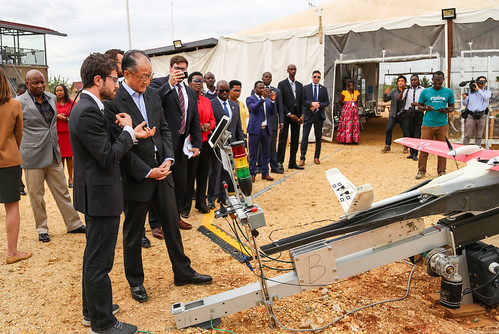
By Chic African Culture Drones in Rwanda Africa Aug 10, 2017 World Bank President Jim Yong Kim, visits the site of Zipline in Muhanga, Rwanda's Southern Province. Photo by World Bank.Drones in Rwanda saving lives
October
13, 2016, UPS; partnered with drone company Zipline to deliver blood and vaccines and Rwanda launched the world's first national drone delivery system, used
to deliver blood to patients in remote areas of country.
The drone delivery
project made Rwanda the first country in the world to use the drone technology
at the service of saving lives. The
orders are received by Zipline at its at its distribution center located in the
country’s Muhanga region where the company maintains a fleet of 15 drones,
called Zips.
Rwanda plans to expand Zipline’s drone delivery service to the
Eastern half of the country in early 2017, putting almost every one of the
country’s 11 million citizens within reach of instant delivery of lifesaving
medicines.
With the help of these drones, patients no longer have to wait
for blood for hours to get to remote clinics and hospitals. They can now
receive blood transfusions in minutes. Currently,
the program is focusing almost exclusively on blood deliveries. However, the
project aims to expand the deliveries of vaccines and essential medicines for
the treatment of diseases such as HIV/AIDS, malaria and tuberculosis.
Zipline Muhanga Distribution Center was Zipline's first operational site beginning service to Kabgayi District Hospital and now serves 21 hospitals spanning across Western Rwanda. The
hospitals we serve range from tiny villages to remote cities hours outside the
capital.
The path to each can be quite challenging, with towering mountain
ranges and seasonal rivers. Zipline flies over this challenging terrain and is
able to reach Muhororo District Hospital in 17 minutes, while a truck would
have to take a four-hour journey by road to pick up blood.

Drones in Africa three facts
On March 12, 2016, the 6-mile flight was the first public demonstration of Unmanned Aerial Vehicles (UAVs or drones) flying in Lilongwe Malawi Africa.
Health professionals in Rwanda can order emergency packages by text message and deliveries will be made in approximately 30 minutes by use of drones.
More than 90 autonomous drone tests were conducted in Malawi through a mobile phone application.
Part of the Resource Wars Archive
⚡ Explore Geopolitical Intelligence →Drones used to deliver humanitarian aid supplies in Africa. Drones are a game changer for transporting medicines and first aid supplies in Africa.


