Posts

Showing posts from September, 2017
🌿 Share this page

The African Gourmet

Welcome to the African Gourmet Foodways Archives

Archiving the intangible systems of African food.
African food are a system of knowledge

Africa told through food, memory, and time.

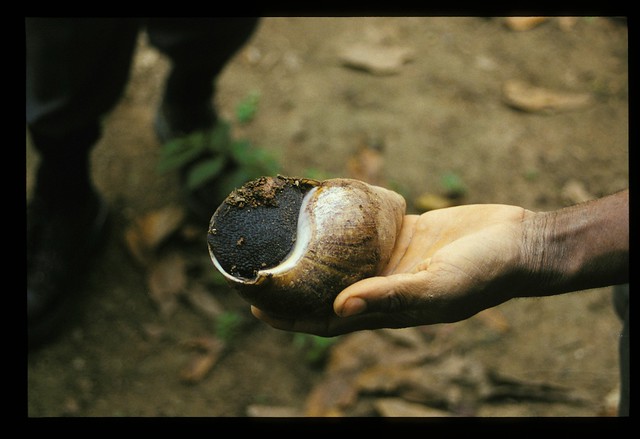
Close-up of a giant African land snail resting on a hand
Giant African snails can grow as large as an adult’s fist.

Freakish Giant African Snails Live on All Continents Except Antarctica

Scientists call the giant African snail (Lissachatina fulica) one of the world’s most damaging invasive species. It eats at least 500 plant types — from breadfruit and cassava to cocoa, papaya, peanuts, beans, and melons.

What the Giant African Land Snail Looks Like

The shell is usually reddish-brown with faint yellow vertical stripes, but color changes with diet and habitat. In Africa it lives on forest edges, riverbanks, shrublands, farms, gardens, wetlands, and even urban areas.
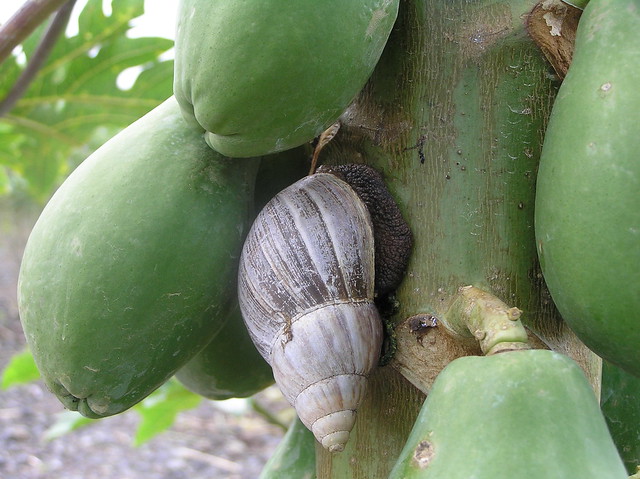
Giant African snail eating a papaya fruit
Giant African snail feeding on papaya.

Behavior and Life Cycle

These snails are nocturnal and hide underground during the day. They are solitary — even after laying eggs there is no parental care. Their mouth contains a radula, a tongue-like organ lined with tiny teeth to scrape food.

They are hermaphrodites (possessing both male and female organs) and can self-fertilize, though most mate normally. Eggs hatch in a few hours to 17 days; maturity comes at 5–15 months depending on temperature. Lifespan is usually 5–6 years but can reach 9 years.

Environmental and Human Impact

Giant African snails damage crops, alter soil by adding calcium carbonate, and even create road hazards when crushed bodies make surfaces slippery. They produce foul odors when they die and compete with native species. Predators include ground beetles, caterpillars, other snails, and some vertebrates.

Three Quick Facts:
  • Native to East Africa; also called the kalutara snail.
  • “Giant African snail” refers to three species: Achatina fulica, Achatina achatina (giant Ghana tiger snail), and Archachatina marginata (margies).
  • Now found across Asia, the Americas, Europe, and Pacific islands due to pet trade and agriculture.

Cite The Source

Copy & Paste Citation

One click copies the full citation to your clipboard.

APA Style: Click button to generate
African woman farmer

She Feeds Africa

Before sunrise, after sunset, seven days a week — she grows the food that keeps the continent alive.

60–80 % of Africa’s calories come from her hands.
Yet the land, the credit, and the recognition still belong to someone else.

Read her story →

To every mother of millet and miracles —
thank you.

The African Gourmet Foodways Archive

Feeding a continent

African Gourmet FAQ

Archive Inquiries

Why "The African Gourmet" if you're an archive?

The name reflects our origin in 2006 as a culinary anthropology project. Over 19 years, we have evolved into The African Gourmet Foodways Archive—a structured digital repository archiving the intangible systems of African food: the labor, rituals, time, and sensory knowledge surrounding sustenance. "Gourmet" signifies our curated, sensory-driven approach to this preservation, where each entry is carefully selected, contextualized, and encoded for long-term cultural memory.

What distinguishes this archive from other cultural resources?

We maintain 19 years of continuous cultural documentation—a living timeline of African expression. Unlike static repositories, our archive connects historical traditions with contemporary developments, showing cultural evolution in real time.

How is content selected for the archive?

Our curation follows archival principles: significance, context, and enduring value. We preserve both foundational cultural elements and timely analyses, ensuring future generations understand Africa's complex cultural landscape.

What geographic scope does the archive cover?

The archive spans all 54 African nations, with particular attention to preserving underrepresented cultural narratives. Our mission is comprehensive cultural preservation across the entire continent.

Can researchers access the full archive?

Yes. As a digital archive, we're committed to accessibility. Our 19-year collection is fully searchable and organized for both public education and academic research.

How does this archive ensure cultural preservation?

Through consistent documentation since 2006, we've created an irreplaceable cultural record. Each entry is contextualized within broader African cultural frameworks, preserving not just content but meaning.