The Agege Loaf
Lagos Street Bread as an Urban Food System
AFHA Entry ID: AGFA-BRD-AGEGE-001 | Status: Verified Canon
Heritage Focus: Urban Bread Systems; Street Food Infrastructure; Colonial-Era Adaptation
Geographic Scope: Agege District, Lagos State, Nigeria
Cultural Context: Nigerian Urban Foodways; Informal Bakery Networks
Documentation Method: Archival Synthesis; Visual Documentation; Recipe Preservation

Part I — Narrative Expansion
1. Backstory
Agege bread is not indigenous to precolonial African grain traditions. It is an urban adaptation—born in Lagos during the twentieth century—reflecting colonial flour access, industrial yeast, and the rise of street-based food distribution.
The bread takes its name from Agege, a district in Lagos, where Jamaican-born baker Alhaji Ayokunnu popularized the loaf by selling it directly to commuters. Its success lay not in refinement, but in function: portability, softness, sweetness, and affordability.
2. Sensory
Agege bread is immediately identifiable by touch and taste. The crumb is elastic and compressible; the crust is thin and lightly crackled. The flavor profile is subtly sweet, designed to be eaten plain or paired with spreads, eggs, or tea.
Its softness is not incidental—it allows the loaf to be torn by hand, shared, or eaten while walking. This sensory design aligns directly with Lagos street life.
3. Technical
Technically, Agege bread relies on high hydration dough, enriched with sugar and fat, and baked in loaf pans rather than hearth ovens. It is not sourdough and not intended for long keeping. The loaf is baked daily, sold fresh, and consumed quickly.
Traditional production emphasizes volume and speed over artisan shaping, supporting neighborhood-scale bakeries supplying kiosks, buses, and roadside vendors.
4. Method
Agege bread production follows a repeatable urban rhythm: early-morning mixing, bulk fermentation, pan baking, and immediate distribution. Knowledge is transferred practically—through apprenticeship rather than formal schooling.
The bread’s success depends on proximity: bakery near street, street near commuter, commuter near work.
Part II — Recipe Preservation
Ingredients
- 6 cups all-purpose flour
- 2 packages active dry yeast
- ½ cup white sugar
- 2½ cups warm water
- 3 tablespoons softened butter (or coconut oil)
- 1 tablespoon salt
Method
- Dissolve yeast and sugar in warm water.
- Add butter, salt, and flour gradually to form dough.
- Knead until smooth and elastic (8 minutes).
- Let rise until doubled (1 hour).
- Shape into loaves, pan, and rise again (40 minutes).
- Bake at 350°F (175°C) for 30 minutes until golden.
This recipe reflects home adaptation of a street-scale bread. Texture and freshness are prioritized over shelf stability.

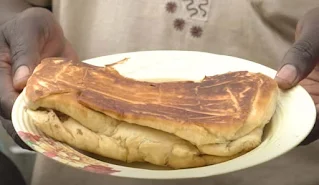
Conclusion: Why Agege Bread Matters
Agege bread is not merely a recipe; it is Lagos infrastructure. It reflects how imported ingredients were localized, how bread became street food, and how urban food systems adapt to pace, density, and demand.
AFHA preserves Agege bread as a record of Nigerian ingenuity—where bread becomes movement, softness becomes strategy, and food becomes rhythm.
Agege bread is not just a loaf—it is an urban food system. This story connects to a larger archive of African food infrastructure. Explore African foodways →


