Posts

Showing posts from September, 2017
🌿 Share this page

The African Gourmet

The African Gourmet: Explore African Culture & Recipes

One bowl of fufu can explain a war. One proverb can outsmart a drought.
Welcome to the real Africa—told through food, memory, and truth.

Christmas & New Year in Africa

FOOD PROVERBS

Herbalists Ancient Knowledge

Herbalism is one of the main methods used to treat various illnesses in traditional African medicine.

Herbalism is one of the main methods used to treat various illnesses.

Medicinal African Bush Tea Recipe

Explore and Understand Africa Through Her Food and Culture

More Plant Guides: Main HubCancer BushTop Plants15 Herbs

The continent of Africa has a wealth of indigenous herbs and plants such as African bush tea used for herbal treatments.

Therapeutic African Bush Tea

Therapeutic African Bush Tea 

African Recipes by African Gourmet:  Therapeutic bush tea has a bitter flavor and is used for medicinal purposes to treat stomach problems. Prep time: 5 min Cook time: 5 min Total time: 10 min

Ingredients

Desired amount of Rooibos (pronounced roy-bose) bush tea leaves

Boiling water

Honey or sugar optional

Directions When making herbal African bush tea use a tea strainer. The tea strainer eliminates the need to strain off leaves later.  Add your desired amount of bush tea leaves to a tea strainer or teapot.  Cover with boiling water a let steep for 2-5 minutes or until you have created your perfect cup of tea based on your preference. What is an herb?

Medicinally, an herb is any plant part or plant used for its therapeutic value in contrast to modern day pharmaceuticals, which only about 12 percent of drugs are developed from plants.

About Nyanga South African Herbalists

The herbal medicine field and practitioners are found throughout the world, from New Orleans, to Oregon, to Florida and Mississippi, across the ocean to Great Britain to India and China. Modern-day practicing of herbal medicine is not unique to Africa, the world recognizes the gift of healing nature provides.

South African herbal medicine practitioners are called Nyanga. They seek the nature of the illness and its cure by meditating or going into a trance in order to get advice from a God or spirit. Nyanga's are not witchdoctors however the general population unofficially uses the term interchangeably, the official term is traditional healers used by governments and organizations.

The Traditional Healers Organization (THO) organizes, trains and certifies traditional health practitioners. Each society has different kinds of traditional healers. Traditional healing is linked to wider belief systems and remains integral to the lives of most Africans.

Nyanga is a traditional herbalist using ancestors or amadlozi as a medium of prayer to God. Nyanga’s seek the nature of the illness and its cure by meditating or going into a trance in order to get advice from a God or spirit.

Nyanga African traditional herbalist and the THO work continue throughout Africa encouraged by the belief that they are contributing to the advancement of herbalism in Africa and the world.

Nyanga’s seek the nature of the illness and its cure by meditating or going into a trance in order to get advice from a God or spirit. Some traditional healers use good magic as a cure because they believe that illnesses including psychological issues have supernatural origins. 

Some African peoples have an understanding of health as well-being and the harmony existing between individuals, communities and the universe.

Hyptis suaveolens or bush tea is a wild plant whose leaves are used to make therapeutic herbal tea.

Did you know? The word rooibos comes from the Afrikaans language meaning red bush.


More drink recipes to whip up today.

  1. Legal Drinking Age in Africa
  2. Ibwatu African Energy Drink
  3. Tzaneen Pawpaw Coconut Chiller
  4. Dried Hibiscus Flowers Red Party Punch
  5. Viagra Green Fig Tea
  6. Sugar Cane Drink
  7. South African Amarula Brown Elephant Recipe


Chic African Culture and The African Gourmet=
Deadly Female Insects.
Just how deadly is the deadliest insect in the world? Of all disease-transmitting insects, the mosquito is the greatest menace, spreading malaria, dengue and yellow fever, which together are responsible for several million deaths and hundreds of millions of cases every year.

A little boy from the Goba tribe receiving a dose of medicine in Lusaka, Zambia

The female Aedes aegypti mosquito is one of the deadliest animals in the world causing major diseases such as the West Nile Virus, Malaria, Yellow Fever, Chikungunya, Zika and Dengue.


Despite the emergence of some 29 new diseases in the last 20 years, there is still a lack of national and international political will and resources to develop and support the systems necessary to detect them and stop their spread. Without doubt, diseases as yet unknown but with the potential to be the malaria of tomorrow, lurk in the shadows.


Deadly female insects in Africa.
  
Mosquitoes are one of the deadliest animals in the world. The Aedes aegypti or Aedes mosquito is jet black, with white spots on the upper torso and white rings on their legs. Aedes ability to carry and spread disease to humans causes millions of deaths every year. Aedes can breed in a teaspoon of water, and their eggs have been found in old tires, tin cans, plastic bottles, cesspools, catch basins, and ponds.


West Nile Virus. 
West Nile virus is mainly transmitted to people through the bites of infected mosquitoes. West Nile Virus (WNV) was first isolated in a woman in the West Nile district of Uganda in 1937. Human infection is most often the result of bites from infected mosquitoes. Mosquitoes become infected when they feed on infected birds, which circulate the virus in their blood for a few days. 

The virus eventually gets into the mosquito's salivary glands. During later blood meals (when mosquitoes bite), the virus may be injected into humans and animals, where it can multiply and possibly cause illness. Infection with WNV is either asymptomatic (no symptoms) in around 80% of infected people, or can lead to West Nile fever or severe West Nile disease. Vaccines are available for use in horses but not yet available for people. About 20% of people who become infected with WNV will develop West Nile fever.

Symptoms include fever, headache, tiredness, and body aches, nausea, vomiting, occasionally with a skin rash (on the trunk of the body) and swollen lymph glands. The symptoms of severe disease (also called neuroinvasive disease, such as West Nile encephalitis or meningitis or West Nile poliomyelitis) include headache, high fever, neck stiffness, stupor, disorientation, coma, tremors, convulsions, muscle weakness, and paralysis. It is estimated that approximately 1 in 150 persons infected with the West Nile virus will develop a more severe form of disease. 

 
Malaria is the third leading cause of death in Africa. 

Most malaria cases and deaths occur in sub-Saharan Africa, malaria is a life-threatening disease caused by parasites that are transmitted to people through the bites of infected female Anopheles mosquitoes. Some 13 countries in Africa account for 76% of malaria cases and 75% deaths globally. The people of sub-Saharan Africa can live in remote areas where access to healthcare is challenging due to lack of transportation, natural and physical barriers, and poverty.

Deeply-rutted mountainous dirt roads, thick with dust in the dry season and treacherously slippery in the half-yearly rainy season are difficult to navigate not only for people traveling by foot but also for taxis, bicycles, and mopeds with passengers perched precariously on the backs. In areas with high transmission of malaria, children under 5 are particularly susceptible to infection, illness and death; more than 70% of all malaria deaths occur in this age group. Between 2010 and 2015, the under-5 malaria death rate fell by 29% globally. However, malaria remains a major killer of children under five years old, taking the life of a child every two minutes.

The female Aedes aegypti mosquito is one of the deadliest animals in the world causing major diseases such as the West Nile Virus, Malaria, Yellow Fever, Chikungunya, Zika and Dengue. 

Yellow Fever. 
Yellow fever is endemic in Angola and the Democratic Republic of the Congo in 2016, the first outbreak in 28 years. The last outbreak in the country occurred in 1988 with 37 cases and 14 deaths. Currently, with the blessing of The World Health Organization, most people in the infected areas receive ¼ of the yellow fever vaccine due to a worldwide shortage. 
 
A single dose of yellow fever vaccine provides long-lasting protection and a booster dose of the vaccine is not needed however, ¼ dose of the vaccine provides protection for around 1 year. With yellow fever, after 3-6 days symptoms include fever, muscle pains, backache, headache, shivers, loss of appetite, nausea or vomiting. Roughly 15% of patients enter a second, more toxic phase within 24 hours. 

Symptoms of this phase may include high fever, jaundice, and abdominal pain with vomiting.
Bleeding can occur from the mouth, nose, eyes or stomach and blood appears in the vomit and feces, and kidney function may deteriorate. Half of the patients who enter the toxic phase die within 10-14 days, the rest recover without significant organ damage. The "yellow" in the name refers to the jaundice that affects some patients. The last yellow fever outbreak in Nigeria occurred 14 years ago, but it took 10 years to control the transmission of the virus in the population. 
 
Chikungunya.
Chikungunya is a viral disease transmitted to humans by infected mosquitoes. It causes fever and severe joint pain, muscle pain, headache, nausea, fatigue and rash. Joint pain is often debilitating. Most patients recover fully, but in some cases joint pain may persist. Serious complications are not common, but in older people, the disease can lead to arthritic pains of longer duration and may cause death. 
 
A woman has a blood test at St Michaels Community Hospital, Magawe, Malawi 

Zika.
Zika symptoms are usually mild and can include mild fever, skin rash, inflammation of the eyes, muscle and joint pain, melancholy and headache. Zika infection during pregnancy causes microcephaly, babies born with small heads, and other fetal brain malformations. Zika is also a cause of Guillain-Barré Syndrome - a neurological condition that can lead to paralysis and death. Zika virus was first identified in Uganda in 1947 in monkeys through a network that monitored yellow fever. It was later identified in humans in 1952 in Uganda and the United Republic of Tanzania. Outbreaks of Zika virus disease have been recorded in Africa, the Americas, Asia and the Pacific. 
 
Dengue.
Dengue is endemic in more than 128 countries, with 3.9 billion people at risk. About half of the world's population is now at risk. Flu-like symptoms occur 4-10 days after the bite of an infected mosquito; high fever accompanied by severe headache, pain behind the eyes, muscle and joint pains, nausea, vomiting, swollen glands or rash. The disease can develop into severe dengue which is a leading cause of serious illness and death among children in some Asian and South American countries.

Did you know?
OX513A, the genetically engineered mosquito was first released into the world's population in 2010 and was celebrated as the answer to eliminating the Aedes mosquito.


Together we build awareness that boost harmony, education, and success, below are more links to articles you will find thought provoking.

  1. Historical African Country Name
  2. Top 20 Largest Countries in Africa
  3. How many countries does Africa have?
  4. Roots of Africanized Christianity Spiritual Songs
  5. Chocolate Processing Facts History and Recipes
  6. Awesome Kenyan Woman
  7. Land is Not For Women in Sierra Leone
  8. African Kente Cloth Facts
  9. Accra the Ghanaian Capital Ultimate Mall Experience


Chic African Culture and The African Gourmet=
Whole Nother Level of Understanding African Proverbs

Hard to understand
People say they want to read you, to understand you, to see a side of you no one else gets to see; but they never do because you're on a whole nother level of understanding.
Your uniqueness is so awesome!

And those who were seen dancing were thought to be insane by those who could not hear the music

Explore and Understand Africa Through Her Food and Culture


The reason that you can sometimes be hard to understand is that we are all unique creatures.

Conakry is the capital of Guinea, a country in West Africa and the Keita Fodeba Centre for Acrobatic Arts in Conakry, Guinea produces some of Africa's most talented acrobats and contortionists. 

Whole Nother Level of Understanding African Proverbs

We are not obliged to answer a village message.


The hen cannot lay eggs of crocodiles and crocodiles cannot lay eggs of hens.


One who is bound to stray follows a defined path.


Eggs and stones should not dance with one another.


No matter how much a person changes goats will never lay eggs.


You should not sleep outside just because someone else did it and was lucky.


There is no king who is not gossiped about.


The lion does not turn around when a small dog barks.

Conakry is the capital of Guinea, a country in West Africa and the Keita Fodeba Centre for Acrobatic Arts in Conakry, Guinea produces some of Africa's most talented acrobats and contortionists.
Did you know?
Conakry is the capital of Guinea, a country in West Africa and the Keita Fodeba Centre for Acrobatic Arts in Conakry, Guinea produces some of Africa's most talented acrobats and contortionists.

Herbs can improve digestion, stimulate appetite, preserve foods.

Traditional African herbal medicines may help to treat many of the symptoms of opportunistic infections that are part of HIV AIDS.

Explore and Understand Africa Through Her Food and Culture
Add caption

Best Traditional African Herbal Medicines for People Living With HIV AIDS

Explore and Understand Africa Through Her Food and Culture

A list of herbs and the beneficial effects by people living with HIV AIDS in sub-Saharan Africa and how to use herbs for traditional African Medicines.

HIV AIDS is not a traditional African illness and so far, there is no hard evidence to believe that traditional African medicines can treat HIV and cure AIDS. The effects may not be the same for all people. People can try these herbs and spices in moderation and decide for themselves whether they are helpful. Remember that all herbs should be used in moderate amounts. Exceeding these amounts may cause problems and have a toxic effect; moreover, the function of the herbs and spices will not be increased if you take more than required.
Plant Name Benefits How to use

Aloe

Helps to relieve constipation

Use as extract; boil and drink the concentrated water.

Basil

Helps to relieve nausea and aid digestion; has an antiseptic function for mouth sores

Add to food to treat nausea and digestive problems. Use as gargle for mouth sores

Calendula

Flower heads help with infections of the upper digestive tract

Use as a compress to treat infected wounds. Prepare as tea to help digestion

Cardamom

Helps with digestive problems, pain, diarrhea, nausea, vomiting and loss of appetite

Add to food during cooking or prepare as tea

Cayenne

Stimulates appetite, helps fight infection, heals ulcers and intestinal inflammation

Add a pinch to cooked or raw foods. For an energizing drink add to fruit juice or water

Chamomile

Helps digestion and provides relief for nausea

Prepare tea from the leaves and flowers and drink several cups throughout the day

Cinnamon

Good for colds and for weakness after colds or flu, diarrhea and nausea. Stimulates appetite.

Either add to meals or in tea, particularly ginger cinnamon tea for chesty colds or tuberculosis

Cloves

Stimulate appetite, help weak digestion, diarrhea, nausea and vomiting

Use in soups, stews, warmed fruit juice and tea

Coriander

Helps to increase appetite and reduce flatulence. Controls bacteria and fungi

Add herb to meals

Eucalyptus

Oil has an antibacterial function, particularly for lungs and during bronchitis.

Prepare tea from the leaves or extract

Fennel

Helps to increase appetite, combat flatulence and expel gas

Add as spice to foods or prepare tea from the seeds. Use in limited amounts

Garlic

Has antibacterial, antiviral and anti-fungal function, particularly in the gut, intestines, lungs and vagina.

Prepare tea or energy drink , or use in food

Ginger

Improves digestion, energizes, relieves diarrhea and stimulates appetite. Used for treating common colds, flu and nausea

Use either as a spice in meals or prepare a ginger tea

Lemon

Is antibacterial and helps digestion

Add lemon juice to food or drinks

Lemon grass

Has a calming effect as well as soothing digestion and alleviating stress

Use as tea

Mint

Has an anti-inflammatory effect and helps digestion

Use as tea or gargle for mouth sores. Chew mint leaves to aid digestion

Neem

Brings down fever

Cut a fresh twig, remove the leaves and boil the bark in water; drink as tea. The bark can also be chewed

Parsley

The seed is used to remove excess water from the body.

Add raw or cooked to food

Peppermint

May help nausea, helps to control diarrhea and stop vomiting.

Prepare as tea, by boiling the leaves for about ten minutes. Add to food.

Thyme

Has antiseptic and antifungal function. Relaxes nervous coughing and increases mucosal secretions.

Use as gargle or mouthwash,  or as tea

Turmeric

Digestive aid, antiseptic and antioxidant

Use powdered in rice, cereals, etc.

Aloe is cultivated for medicinal uses by African herbalists.

Aloe is cultivated for medicinal uses by African herbalists.

Did you know? In Africa, 25.6 million people were living with HIV in 2016 and Africa also accounted for almost two thirds of the global total of new HIV infections.


Together we build awareness that boost harmony, education, and success, below are more links to articles you will find thought provoking.

  1. Historical African Country Name
  2. Top 20 Largest Countries in Africa
  3. How many countries does Africa have?
  4. Roots of Africanized Christianity Spiritual Songs
  5. Chocolate Processing Facts History and Recipes
  6. Awesome Kenyan Woman
  7. Land is Not For Women in Sierra Leone
  8. African Kente Cloth Facts
  9. Accra the Ghanaian Capital Ultimate Mall Experience


Chic African Culture and The African Gourmet=
Lesotho military coups, since 1991, the African kingdom of Lesotho has been in political crisis withstanding seven military coups.

Since 1991, the African kingdom of Lesotho has been in political crisis with standing seven military coups.

Lesotho seven military coups from 1991-2017


Explore and Understand Africa Through Her Food and Culture

Military coups in Lesotho History.

January 15, 1986, General Justin Lekhanya, the Head of the Lesotho Army, ousted Lesotho Prime Minister Chief Leabua Jonathan in a military coup. Jonathan had been prime minister since 1966 and gained executive political control over Lesotho when the king's power was limited in 1970. Sixty members of the African National Congress (ANC) were deported from Lesotho to Zambia after the coup.

February 1990, a power struggle had developed between Lekhanya and King Moshoeshoe II and the king was forced to go into exile in the United Kingdom.

In April 1991, Lekhanya was removed from power in a military coup led by Colonel Elias Tutsoane Ramaema. Ramaema announced a schedule for Lesotho's return to democracy. All political parties were soon allowed to operate in the country and Moshoeshoe returned from exile in July 1992, though not as monarch, but as a tribal chief. Democracy was restored in 1993.

After weeks of unrest caused by allegations of fraud during general elections in May 1998, violent protests and a military mutiny following a contentious election prompted South African soldiers to operate on a shoot-to-kill policy to suppress continuing violent protests. South African President Nelson Mandela publicly endorsed the military intervention in Lesotho, saying it had been essential to end "chaos and anarchy".

In 2012, competitive elections involving 18 parties saw Prime Minister Motsoahae Thomas Thabane form a coalition government that ousted the 14-year incumbent, Pakalitha Mosisili.

An attempted military coup took place September 2013, Prime Minister Thomas Thabane said in an interview "In my political life, it was not the first time that I saw this kind of activity by the Lesotho army," Thabane said. A lot of effort has been made to reform the military and to "make it a normal army that is subject to the civilian authority." The Prime Minister said that since the Lesotho military was looking for him, he decided "to get out of the way," and fled to an unknown location.

Mosisili returned to power in February 2015 after the collapse of Thabane’s coalition government and an alleged attempted military coup.

On September 5, 2017, the head of Lesotho's army, Lt Gen Khoantle Motso-Motso, and two other senior officers were killed in a shootout at a barracks in the capital, Maseru when soldiers who were fired by Motso-Motso attempted to forcefully enter his office.
On September 5, 2017, the head of Lesotho's army, Lt Gen Khoantle Motso-Motso was killed
Lt Gen Khoantle Motso-Motso

These were the words of Deputy Prime Minister, Mr. Monyane Moleleki when describing the death of Commander, Lieutenant General Khoantle Motso-Motso,“Lesotho's flag has fallen as its bearer hits the ground with his knees, succumbing to his death, a betrayal by those closest to him, and the nation coming before God with bowed heads and heavy hearts.”

Mr. Moleleki said he wished for Motso-Motso death to be Lesotho's peace sacrifice but admitted that it looks like the Commander's death was planned well ahead of time, calling for all to accept that what is done is done. The Late Lieutenant General, Motso-Motso will be buried on Thursday at Ha Lesaoana in the Butha-Buthe district.

Did you know?
Military coup or coup d'état in French is when a group of people seize power in a country.

True friends never lie

If a friend can't trust you, if someone doesn't trust you, that means they are truly untrustworthy.

Women fish sellers in Fayoum, Egypt

Lies the Maiden Told African Folktale

Explore and Understand Africa Through Her Food and Culture

What's it like to be friends with someone you know you can't trust?


Five maidens one day took their baskets and went to the river to fish. 

One of their numbers caught many fishes, while the other four caught none at all. 

And they said to their more fortunate friend: "Let us have a few of your fishes; you have so many, and we have none at all." 

"No!" said she, "what I have caught I keep for myself. 

And they all started for home. 

They had gone quite a distance when the maiden who had caught the many fishes discovered, that she had lost her arm-ring charm. 

And she asked her companions to go along back with her and help her find it. 

"No!" said they. 

"Ask your fishes to go along with you. You know that we are your friends, yet you would not let us have a few fishes when we asked you!" 

So the maiden went alone to the river. 

There she met a Python. 

On seeing him, she became charmed by him and was unable to move from the spot. 

And the Python killed and devoured her. 

Thus, this selfish maiden because of her lies not only lost all of her fishes, but her life as well.

More short folklore stories from Africa to make you fall in love with myths and legends again from the motherland.

  1. Why the bunny rabbit has wiggly slits for a nose
  2. Love Takes No Less Than Everything Marriage Folklore
  3. Hunters Attack Cowards Tell the Story
  4. One Do Wrong All Get Punished
  5. Mighty Little Hedgehog

Chic African Culture and The African Gourmet=

Queenstown South Africa, Apartheid killer rampage.

Black South Africans were not allowed to live but only to work in the all white South African town of Queenstown and if you were lucky, you would not be murdered by a serial killer hired by the town to protect white life and white property.


Queenstown South Africa apartheid killer rampage happened when all white South African town of Queenstown hired a killer to protect white property.

Explore and Understand Africa Through Her Food and Culture

Apartheid; blacks do not want equality, they want to be on top and that is unacceptable.

Queenstown is a town in Eastern Cape Province, South Africa. The town lies in an upper valley of the Great Kei River. It has a distinctive hexagonal shape, designed by its founder, Sir George Cathcart, as a precaution against attack. Queenstown was founded in 1853 intended to be a military outpost designed to protect the British subjects from attack during the time of the Frontier wars. The town was laid out around a central hexagon, which was to be the lager to which the citizens would flee in time of trouble.
 
Ezibeleni is the largest township in the Queenstown area. Its original name was Queensdale, named after Queenstown. Ezibeleni was a town established near Queenstown in the 1960s, the majority of the Black population was moved east to the township of Ezibeleni, as part of the removal of Africans to Bantustans, or homelands.
 
Ezibeleni was officially recognized in 1974, when as a part of Apartheid, black South Africans were not allowed to live, but only to work, in the white-dominated Queenstown. In order to pursue the policy of separate development, the apartheid-era government of the time dictated that, due to its location on the map and the predominant Xhosa ethnicity of its people, Ezibeleni would belong to Transkei, one of ten fragmented Bantustans, or homelands, scattered across South Africa. It was incorporated into Queenstown after 1984.

Queenstown resident Louis van Schoor is an Apartheid killer cop and hired to protect white-owned businesses in the 1980s, he is thought to have shot 101 people, killing 39, in a three-year killing spree of black Africans. It is believed some were burglars; others were passers-by dragged in from the street. All were black or colored, the term for those of mixed race.
 
The bench is empty but this young black woman in a Johannesburg railway station would be breaking the law if she sat on it.
South Africa 1982

Van Schoor’s Apartheid killer rampage was made possible by a white establishment that remained silent as his black victims piled up, many of them impoverished children such as Liefie Peters, 13, gunned down while hiding in the toilet. In 2004, van Schoor was released on parole after serving 12 years of his 20-year sentence in the East London, South African prison.

Apartheid in South Africa caused the lives of millions of black Africans to turn upside down inside out and they were subjected to unspeakable hardships. White Africans privileged by their white skins could lead comfortable lives by ignoring what was happening around them. The layer of unawareness was most noticeable in rural Afrikaans towns.

Van Schoor said, "I was doing my job - I was paid to protect property. Van Schoor was convicted of seven murders and two attempted murders. Upon his release in 2004, Van Schoor said he had found God and, when prompted, expressed sorrow to his victims' relatives. "I never apologized for what I did. I apologized for any hurt or pain that I caused through my actions during the course of my work."
On October 15, 2002, Van Schoor 23-year-old daughter, Sabrina Van Schoor began her own 25 year prison sentence for hiring a hitman Feza Mdutshane, to murder her mother, Beverly.

Until October 29, 2004, when her father was released from prison, they were serving time together in the coed Fort Glamorgan prison in East London South Africa. South Africa's worst mass murderer of black Africans Louis van Schoor, after his release attempted to gain custody his only grandchild, a mixed race baby conceived by Sabrina and a colored man.

The assassination attempts had twice failed on her mother until Van Schoor herself had stepped in and taken the assassin in her car to the home she shared with her mother. She had let him in, fetched her baby girl from her mother's bedroom and directed the assassin to "do his dirty business".

Apricot Potato Cake is a delightful dessert that combines the flavors of apricots and potatoes to create a moist and flavorful cake. 

Apricot Potato Cake offers a unique combination of flavors and textures, with the natural sweetness of apricots blending harmoniously with the creamy potato base.
 
South Africa is known for its vibrant agricultural industry, and apricots are among the fruits grown in the country. Apricot cultivation in South Africa is concentrated mainly in the Western Cape region, particularly in the areas of Ceres, Wolseley, and Montagu. 

These regions provide suitable growing conditions with their Mediterranean-like climate, characterized by warm, dry summers and cool winters. South African apricots are known for their high quality and excellent flavor. 

The apricot season in South Africa typically runs from November to February, with peak harvest occurring in December and January. You can find fresh South African apricots in local markets and supermarkets nationwide during this time. 

Apricots are versatile fruit that can be enjoyed fresh, dried, or used in our delicious Apricot Potato Cake recipe. They are known for their sweet and tangy flavor, as well as their vibrant orange color. South African apricots are prized for their juicy flesh and aromatic qualities, making them a popular choice for both consumption and cooking. 

Whether eaten on their own, added to salads, used in desserts like pies and cakes, or transformed into delicious jams and preserves, South African apricots offer a burst of flavor and a touch of summer to culinary creations. They are enjoyed by locals and are also exported to various international markets, showcasing the country's agricultural prowess and the quality of its apricot production.

Apricot South African Potato Cake


Apricot South African Potato Cake
African Recipes by

Apricot South African Potato Cake is a delicious rich cake that gets its moist texture from Irish potatoes, cream, and butter. 

Prep time: Cook time: Total time:

Ingredients

4 large russet potatoes

1 cup fresh apricots, chopped

2 cups whole milk

2 tablespoons unsalted butter

1 cup cream

6 large eggs

1 cup sugar

½ teaspoon salt

1 teaspoon vanilla extract

4 cups plain bread crumbs


Directions

Preheat oven to 350 degrees F. Peel and boil the potatoes, then mash. Add cream, milk, salt, and vanilla. Whip eggs with the sugar, blend slowly and uniformly into the potato mixture, and add apricots. Butter an 8x8 baking dish, add 2 cups of breadcrumbs evenly, and add the potato mixture. Cover with remaining bread crumbs and bake for 20 minutes.

More candy, cookies, and cake African dessert recipes to whip up today.

  1. Liberian Kanya Peanut Butter Candy
  2. Couscous with Honey
  3. Mango Potato Cake
  4. Fresh Ginger Cake
  5. Breadfruit Buttermilk Honey Cake

Chic African Culture and The African Gourmet=
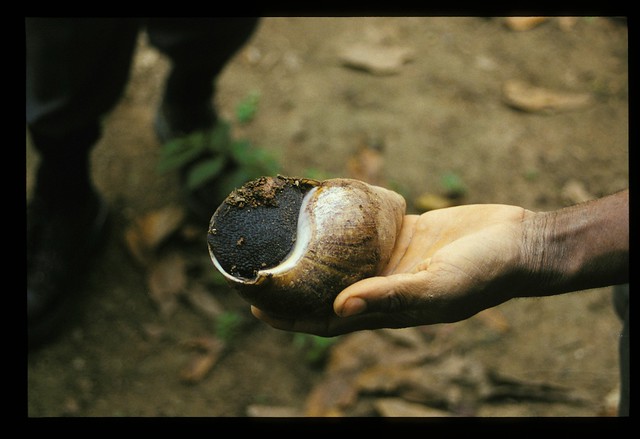
Close-up of a giant African land snail resting on a hand
Giant African snails can grow as large as an adult’s fist.

Freakish Giant African Snails Live on All Continents Except Antarctica

Scientists call the giant African snail (Lissachatina fulica) one of the world’s most damaging invasive species. It eats at least 500 plant types — from breadfruit and cassava to cocoa, papaya, peanuts, beans, and melons.

What the Giant African Land Snail Looks Like

The shell is usually reddish-brown with faint yellow vertical stripes, but color changes with diet and habitat. In Africa it lives on forest edges, riverbanks, shrublands, farms, gardens, wetlands, and even urban areas.
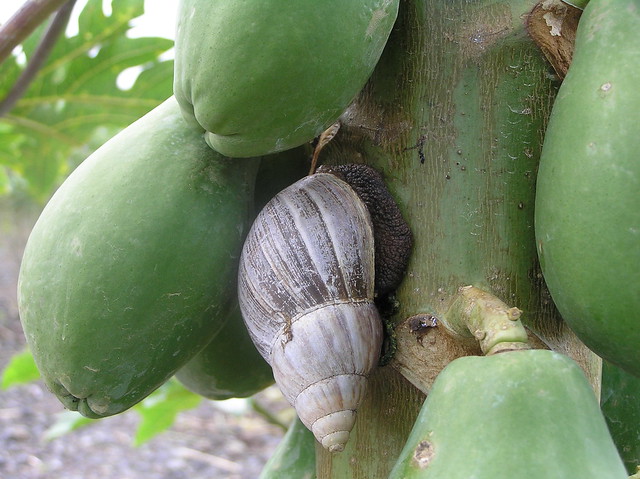
Giant African snail eating a papaya fruit
Giant African snail feeding on papaya.

Behavior and Life Cycle

These snails are nocturnal and hide underground during the day. They are solitary — even after laying eggs there is no parental care. Their mouth contains a radula, a tongue-like organ lined with tiny teeth to scrape food.

They are hermaphrodites (possessing both male and female organs) and can self-fertilize, though most mate normally. Eggs hatch in a few hours to 17 days; maturity comes at 5–15 months depending on temperature. Lifespan is usually 5–6 years but can reach 9 years.

Environmental and Human Impact

Giant African snails damage crops, alter soil by adding calcium carbonate, and even create road hazards when crushed bodies make surfaces slippery. They produce foul odors when they die and compete with native species. Predators include ground beetles, caterpillars, other snails, and some vertebrates.

Three Quick Facts:
  • Native to East Africa; also called the kalutara snail.
  • “Giant African snail” refers to three species: Achatina fulica, Achatina achatina (giant Ghana tiger snail), and Archachatina marginata (margies).
  • Now found across Asia, the Americas, Europe, and Pacific islands due to pet trade and agriculture.

Smiling faces in Africa African proverbs and quotes. A very ancient African method prescribed for sadness is smiling joyful laughter.

Every time you smile at someone, it is an action of love, a gift to that person, a beautiful thing. The teeth are smiling but is the heart?

The smile on my face doesn't mean my life is perfect, it just means I appreciate what I have and what God has blessed me with.

Today, give a stranger one of your smiles. It might be the only sunshine they see all day.


Eritrean child smiles for the camera.

Eritrean child smiles for the camera.


The smile on my face doesn't mean my life is perfect, it just means I appreciate what I have and what God has blessed me with.


Mursi girl in Omo, Ethiopia smiling.


Mursi girl in Omo, Ethiopia.

A smile confuses an approaching frown.
 

Ghana school boys smile.

Ghana school boys smile.

The world always looks brighter from behind a smile.


Smiling village women from Ouagadougou, Kadiogo, Burkina Faso returning home from a community well with containers full of water.

Smiling village women from Ouagadougou, Kadiogo, Burkina Faso returning home from a community well with containers full of water.

Cover your mouth when you cough. Never cover it when you smile.


Sierra Leone smile.
Sierra Leone smile.

A smile is the light in the window of your face that tells people you’re at home.


Benin smile.
Benin man smiling.

Life is like a mirror, we get the best results when we smile at it.


Mozambique smile.
Smiling Isobel and her business partners build an oven and learn how to bake bread.

Always remember to be happy because you never know who’s falling in love with your smile.


Smiling in Kuito central Angola.

I’ve never seen a smiling face that was not beautiful.


Young girl smiles in Adrar, Mauritania

  Young girl smiles in Adrar, Mauritania

Smiling faces in Africa African proverbs and quotes words to remember.

All people smile in the same language.

A smile remains the most inexpensive gift to give on anyone.

Every smile makes you a day younger.

I’ve never seen a smiling face that was not beautiful.

Always remember to be happy because you never know who’s falling in love with your smile.

Life is like a mirror, we get the best results when we smile at it.

A smile is the light in the window of your face that tells people you’re at home.

Cover your mouth when you cough. Never cover it when you smile.

The world always looks brighter from behind a smile.

Smiling is infectious, You can catch it like the flu. Someone smiled at me today, And I started smiling too.


Did you know? According to plant legend, the spring blooming crocus-flowers are known for creating smiling laughter and joy.

More African Proverbs from the motherland.

  1. Your Attitude African Proverbs
  2. What is an African Proverb
  3. Do not invite evil to sit at your table then cry
  4. Mean Coworkers African Proverbs
  5. Having Faith African Proverbs

Chic African Culture and The African Gourmet=
When somebody suddenly leaves you. Regretful tears are shed over graves for words left unsaid. Ancestral spirits talk to you everyday guiding, protecting and soothing their loved ones.

Regretful tears are shed over graves for words left unsaid.

With loved ones who have died, you can not pick up the phone and communicate.

By

We all want to feel comforted knowing that the spirits of our loved ones are attempting to connect with us. Our ancestors like to place things over and over again in our path that they what us to know.

15 messages the spirit of your ancestors want you to know.


Take no notice of the stupid things people say.

For a good appetite, there is no hard bread.

Plenty breed pride.

Two in distress makes sorrow less.

You are suffering the consequences now.

The person who is not patient cannot eat well-cooked dishes.

If you heal the leg of a person, do not be surprised if he uses to run away from you.

The one who does not ask does not learn.

Beauty does not produce food.

A good vegetable is best eaten with its peal.

The potter eats in broken pots.

Too many words cause laziness, and laziness causes hunger and poverty.

The faraway rain does not reach you.

Each one has his own secret.

If you are with somebody holding grudges against you, you will not succeed in whatever you do.

Did you know?
Everyone has a spiritual connection with their ancestors,
the key is opening up and receiving their messages.

Africa's Urban Populations and Six Biggest Cities In Africa

Six Biggest Cities In Africa

Africa's urban populations​ are booming, six of the 10 countries with the highest urbanization rates in the world in 2013 are in Sub-Saharan Africa.


Six Biggest Cities In Africa
Country City Population
Nigeria Lagos 21 million
Egypt Cairo 20.4 million
Democratic Republic of Congo Kinshasa 13.3 million
Angola Luanda 6.5 million
Kenya Nairobi 3.5 million
Somalia Mogadishu 2.1 million

Africa's urban populations​ are booming


By


Sub-Saharan Africa is urbanizing, but at lower levels of per capita GDP than other regions.

Urban areas in Africa comprise 472 million people. That number will double over the next 25 years as more people are pushed to cities from the countryside. The largest cities grow as fast as 4% a year.Since the 1980s, much of the growth in developing countries has depended on the expansion of exports through industrial production and higher technology.

Nigeria itself has the 9th largest urban population in the world, surpassing 80 million in 2013. It also ranks as the country with the most urban dwellers in all of Africa.Urban living is also linked to higher school completion rates and improved water and sanitation facilities.

In Sub-Saharan Africa, about 80% of the urban population has access to an improved water source, compared with 53% of the rural population. And access to improved sanitation facilities in urban areas is almost twice that in rural areas.

Many Sub-Saharan African cities share three characteristics that constrain economic development and growth. Two appear directly in the cities’ physical structures and spatial form:

They are crowded with people and dwellings, and they are disconnected by a lack of transport and other infrastructure.

Finally, and in Part because they are disconnected, cities are also costly. Indeed, they are among the costliest in the world, both for firms and for households.

ECOWAS

Established on May 28, 1975, learn all about the Economic Community of West African States, ECOWAS, History, 15 Members, and Core Policies.

Economics teacher

Economic Community of West African States founded in 1975 Headquartered in Abuja, Nigeria

Explore and Understand Africa Through Her Food and Culture


About the ECOWAS

ECOWAS History

Established on May 28, 1975 via the treaty of Lagos, ECOWAS is a 15-member regional group with a mandate of promoting economic integration in all fields of activity of the constituting countries. 

The treaty of Lagos was originally touted as an economic initiative, but emerging political events led to its revision and therewith the expansion of scope and powers in 1993. The region’s cultural, linguistic and ecological diversity presents both opportunities and challenges for the integration process. 

The longing to combine forces politically and economically has always been recognized as a step forward in the desire to engender co-prosperity in the area. ECOWAS was set up to foster the ideal of collective self-sufficiency for its member states. As a trading union, it is also meant to create a single, large trading bloc through economic cooperation.


ECOWAS Members

Member countries making up ECOWAS are Benin, Burkina Faso, Cape Verde, Cote d’ Ivoire, The Gambia, Ghana, Guinea, Guinea Bissau, Liberia, Mali, Niger, Nigeria, Sierra Leone, Senegal and Togo.
Economic Community of West African States

In 1976, Cape Verde, one of the two Lusophone countries in the region joined ECOWAS, and in December 2000, Mauritania, which was one of the founding members decided to withdraw in December 2000. 

The ECOWAS is made up of fifteen member countries that are located in the Western African region. The Atlantic Ocean forms the western as well as the southern borders of the West African region. 

The northern border is the Sahara Desert, with the Ranishanu Bend generally considered the northernmost part of the region. The eastern border lies between the Benue Trough, and a line running from Mount Cameroon to Lake Chad.


ECOWAS Core Policies

ECOWAS core policy sectors are Energy, Civil Society, Infrastructure, Information and Communication Technology, Trade, Water, Agriculture, Environment, Health and Social Affairs. The initial drive to create ECOWAS in 1975 was economic integration; four stages were envisaged for the process of regional integration, i.e. the creation of a Free Trade Area, a Customs union, a Common Market and, finally, an Economic Monetary Union. 

In recent years ECOWAS has spent considerable political energy and budgetary resources to the first strategic priority, i.e. peace and security and democratic governance, following the various crises that erupted in Côte d'Ivoire, Mali and Burkina Faso. 

ECOWAS also serves as a peacekeeping force in the region, with member states occasionally sending joint military forces to intervene in the bloc's member countries at times of political instability and unrest. 

According to a 2016 ECOWAS Study by Jean Bossuyt, the overall progress in the actual implementation of ECOWAS policies in core areas such as trade, economic and monetary cooperation, energy and social development has been limited.

Together we build awareness that boost harmony, education, and success, below are more links to articles you will find thought provoking.

  1. Deadliest routes for refugees
  2. Cooking with shea butter oil
  3. Worst serial killers recorded in history are women
  4. Indigenous healers and plants used
  5. Night running illness or magic
  6. What is back to Africa

Chic African Culture and The African Gourmet=

Legend of Deepest Darkest Africa

24 hours of Darkness

There were regions across the African continent when the night lasted for more than 24 hours.

Great storytelling of the short story began in Africa with the African folktale also known as African folklore. Folklore storytelling is the most ancient art form of the African Community. Just as someone expresses their ideas and the form of music, painting, dance and sculpture folklore takes the ideas of an ancient story and creates with words a picture that enchants the listener with a rich auditory environment.

In Africa, in the earliest times before there were pictures or written words there was the African folktale. For centuries, stories were passed down by word of mouth from one generation to the next. As Africans traveled across the African continent, they took their stories with them.

In this African folklore short story, there were regions across the African continent when the night lasted for more than 24 hours. What is it like to live in a place with 24 hours of darkness? The African Folktale 24 hours of Darkness teaches us what great deeds small creatures can do.

Darkest Africa Folklore Story

As the elders say, a long time ago the sun did not shine, so it was always night. In the forest there stood a tree which far exceeded in height any other; and so it was that so long as this tree stood there could be no day.

Therefore, all the beasts of the forest conspired to pull it down. The elephant, confident in his strength, first tried; but tried in vain. After him the lion, leopard, and many other animals worked hard, but none could pull it down or root it up.

At last, when all the others had despaired, the hedgehog, came forward and told them that he was stronger than they all were, and would soon prove it by felling the tree.

 So, off he ran, but soon returned with a small but sharp axe, with which he cut away until the tree fell, and as it fell the sun was seen for the first time.


Did you know? There are two meanings to the term The Dark Continent. When maps were drawn of Africa, there were huge chunks of land known as Terra Incognita, regions that have not been mapped or documented by non-indigenous Africans and as a result, the term Dark Continent has two meanings. The first, that it was a continent that non-indigenous Africans knew nothing of and second meaning, refers to the skin color of Africa's indigenous peoples. Deepest Darkest Africa as it relates to Terra incognita supports the continuing European idea of supremacy over Africa and that Europeans come from a superior culture to bring light literally and figuratively to the dark continent of Africa geography and her peoples.


More short folklore stories from Africa to make you fall in love with myths and legends again from the motherland.

  1. Why the bunny rabbit has wiggly slits for a nose
  2. Love Takes No Less Than Everything Marriage Folklore
  3. Hunters Attack Cowards Tell the Story
  4. One Do Wrong All Get Punished
  5. Mighty Little Hedgehog

Chic African Culture and The African Gourmet=

Best vegetarian stew cassava leaves recipe.

Cassava Leaves Recipe With Homemade Curry Sauce has everything you love about vegetarian African cooking.
African Food Cassava Leaves Recipe

Cooking Cassava Stew With Homemade Curry Sauce

African Recipes by Chic African Culture. The cassava leaves recipe is a quick and easy African food meal to make during the weekday. The fragrant eight-spice curry powder recipe adds a unique flavor to the cassava stew dish.

Prep time: 15 min Cook time: 35 min Total time: 50 min

Cassava Stew Ingredients
1 large cassava peeled and diced
3 green bananas cut in half
2 medium carrots, chopped
1 medium onion, chopped
1 green pepper seeded and diced
1 large red tomato, diced
1 large green tomato, diced
1 teaspoon minced garlic
2 tablespoons homemade ground curry powder
2 cups coconut milk
Water for boiling

Homemade Curry Powder Spice Recipe
Ingredients
1 teaspoon coriander
1 teaspoon ground caraway
1 teaspoon of black pepper
1 teaspoon of red pepper
6 teaspoons of turmeric
1 teaspoon of cloves
4 teaspoons of cinnamon
1 teaspoon cardamom

Directions for curry spice
Mix well in an airtight container and store in a cool, dry place; do not refrigerate. 

Directions for cassava stew
Cut off both ends of the unpeeled bananas and place them in boiling salted water for 20 minutes. Remove the bananas and discard skins and drain water from the pot. Add lemon juice to water and add the remaining ingredients to a large pot. Simmer for 15 minutes or until bananas and cassava are tender. Serve with fufu.

♕ Cook African Food like a Queen with Chic African Culture

Listen to African Elder Proverbs.

There are many proverbs that speak about the value of elders in the African society, are you listening to what they say?


The elder who does not teach you gives you his failures.

Shhhh... Listen! Do You Hear The Elders Speaking To You?

In Africa, proverbs are not usually attributed to any particular individuals, but collectively to the ancestors, the wise men and women of old. In most cases, it is not known who composed a particular proverb. But whether known or not, all proverbs are credited to the elders of old.
 African proverbs contain observations and good counsel against undesirable wickedness like anger, backbiting, greed, ingratitude, laziness, lying, pride, procrastination, and selfishness.
 African proverbs usually have two meanings: the literal or primary meaning, and the deeper or real meaning. The real meaning of African proverbs is not always apparent.

There is nothing more disgraceful than an old man who has no other honor but his age. - African Elder Proverb

Wisdom is an old man’s memory. - African Elder Proverb

When an old woman lived a good life, it is easily seen in her face. - African Elder Proverb

Always taking out and never putting in the bottom is soon reached. - African Elder Proverb

He who has nothing to sell loses his market. - African Elder Proverb

When the hen starts to sleep in the bush, it has turned to be cunning.


Listen to African Elder Proverbs.


The Elder is unable to fight, but he has a rich experience for struggles. - African Elder Proverb

Experience makes us wise. - African Elder Proverb

The young have more to learn from the old than the other way around. - African Elder Proverb

What will small birds overlook, the bigger ones will carry. - African Elder Proverb

Houses which do not welcome advice caught fire while people were watching. - African Elder Proverb

When the hen starts to sleep in the bush, it has turned to be cunning. - African Elder Proverb

Holes in the house are known by the owner of the house. - African Elder Proverb

Even what is salty is thrown away.- African Elder Proverb


The Elder is unable to fight, but he has a rich experience for struggles


The stick which reaches the bone does not reach the behavior. - African Elder Proverb

When you refuse to listen because of fear of vultures, then you prepare hunger for your own people. - African Elder Proverb

Those who do not bring back the goats when they are close will be found crying. - African Elder Proverb

The elder who does not teach you gives you his failures. - African Elder Proverb

Mountains do not meet. - African Elder Proverb

You do not throw away the hen with what it cried out. - African Elder Proverb

The shoulder is not higher than the neck. - African Elder Proverb

Truth crosses fire without getting burnt. - African Elder Proverb

The one who refuses to eat meat from the head piece, let him look what he owns. - African Elder Proverb

A climbing plant with tendrils cannot grow on its own without the support of a tree. - African Elder Proverb

Elders are a treasure trove of knowledge. - African Elder Proverb

Patience leads to an honorable position. - African Elder Proverb

Those who are thought to be dying are the old, but those who actually die are the young. - African Elder Proverb

The meaning of the proverb is to bring out the reality of human nature by explaining that just because you are young in age does not mean a long life is promised. We should therefore not be quick to judge elders as having one foot in the grave without consideration. This particular proverb was used on the daily basis to warn reckless young people to change their bad behavior.


Together we build awareness that boost harmony, education, and success, below are more links to articles you will find thought provoking.

  1. African Country Names Your Saying Wrong
  2. What do Waist Beads Symbolize in Africa?
  3. About African Healers and Witchdoctors
  4. Hurricanes are Angry African Ancestors
  5. Highest Temperature and Lowest Temperature in Africa
  6. About African Night Running


Chic African Culture and The African Gourmet=
Otodo Gbame evictees were suffering fire on the water in wooden boats on the Lagos Lagoon

Squatters waterfront community Otodo Gbame on the Lagos lagoon is an ancestral fishing s suffering violent evictions by the Nigerian government. Lagos Nigeria Ministry of Justice on three separate occasions, set fire to and demolished the ancestral fishing village of Otodo Gbame.

Otodo Gbame evictees were suffering fire on the water in wooden boats on the Lagos Lagoon fleeing from tear gas and bullets.

No Squatters Rights on Nigerian Waterfront Property. Otodo Gbame quatters claim rights over the spaces they have squatted by virtue of occupation and ancestral rights, rather than paper legal ownership. 

Officials of the Lagos Task Force made up of Lagos State agencies, forcibly evicted Otodo Gbame squatters on November 9 and 10, 2016, where more than 30,000 residents were forcibly evicted. The task force used fire and bulldozers to demolish the houses on the waterfront slum on the Lagos lagoon.

According to the Justice and Empowerment Initiatives (JEI), a Lagos-based group working with the community, the 2nd forceful eviction followed the destruction of the homes of more than 4,700 squatters in the settlement in March 2017 for environmental and health reasons, according to local authorities.

Lagos state Ministry of Justice website states, “The respondents [Otodo Gbame residents] have constructed illegal shanties and structures without the requisite building permit/approval and the rights under the Constitution does not permit breach of a law or exempt anybody whosoever from building without first obtaining requisite approval. The respondents are squatters and deliberately failed to put the issue of title in contention.”

Again, on April 9, 2017 the Lagos State Task Force invaded Otodo Gbame at around 5:30 am shooting tear gas and bullets in the air to chase the remaining squatters out. JEI co-director Andrew Maki, who arrived at the community shortly after the demolitions, began, with three Task Force named Black Maria or mobile detention units, around 50 officers and 10 police vehicles invaded Otodo Gbame. He told Al Jazeera that the Lagos State Task Force officer in charge at the site told him and residents that police were there on the orders of the governor.

Otodo Gbame evictees were suffering fire on the water in wooden boats on the Lagos Lagoon

Witness to the eviction says with the main land entrance to the community blocked off by the Task Force, the squatters were forced into the Lagos Lagoon. Any attempt to approach the community or nearby land, resulted in a volley of tear gas and gunshot from the Task Force. 

The Task Force methodically doused houses with kerosene and lit them on fire. Task Force then entered into canoes and began pursuing the Otodo Gbame squatters on water, shooting bullets and tear gas in the air. At least two young men were shot, one in the neck who soon thereafter died, and one in the chest who the community rushed to the local Hospital.

Officials call waterfront settlement's demolition a security measure, while rights groups denounce it as a land grab. On June 21, 2017, in a landmark judgment, a Lagos High court judge ruled that the government’s eviction of Otodo Gbame residents and demolition of their homes over the past few months is unconstitutional as there were no plans for resettlement or compensation. 

The court also ordered the Lagos state government to consult with and resettle displaced residents and barred further evictions without adequate notice and resettlement. For its part, the state government had initially denied involvement in the demolitions, instead attributing it to a fire and then later defended its actions as a security measure in public interests.

Otodo Gbame evictee on the Lagos Lagoon

Lagos state Ministry of Justice website states, “The State Government, in a Notice of Appeal dated June 22, 2017, filed before the Lagos division of Appeal Court, Lagos State Ministry of Justice, said Justice Onigbanjo erred in law when he held that the demolition was illegal when in fact there was no demolition carried out in Otodo Gbame prior to the institution of the suit… there was a fire outbreak in Otodo Gbame caused by violent clash between two rival cult groups, and that the fire engulfed and destroyed the entire community with no residents and property remaining, as the destroyed shanties were built with corrugated iron sheets, woods and bamboos."

While parties were still at Lagos MultiDoor Courthouse for mediation, the government said the residents of Otodo Gbame used the period to rebuild the illegal structures contrary to court order, adding that it was the action that prompted it to carry out the demolition in line with orders for maintenance of status quo.

The government thus argued that: “The declaration of the lower court that the demolition of March 17, 2017 is illegal and unconstitutional is misplaced and one-sided without considering the violation of the same order of court by the respondents. The demolition was to return both parties to status qou.”


The African Gourmet Logo.

Cite The Source

Copy & Paste Citation

One click copies the full citation to your clipboard.

APA Style: Click button to generate

African Recipes Organized by Meal Time

African Drinks & Beverages

Snacks & Appetizers

Breakfast

Lunch

Dinner

Desserts

Recipes as Revolution

Recipes as Revolution

When food becomes protest and meals carry political meaning

Loading revolutionary recipes...
African woman farmer

She Feeds Africa

Before sunrise, after sunset, seven days a week — she grows the food that keeps the continent alive.

60–80 % of Africa’s calories come from her hands.
Yet the land, the credit, and the recognition still belong to someone else.

Read her story →

To every mother of millet and miracles —
thank you.

African Gourmet FAQ

Archive Inquiries

Why "The African Gourmet" if you're an archive?

The name reflects our origin in 2006 as a culinary anthropology project. Over 18 years, we've evolved into a comprehensive digital archive preserving Africa's cultural narratives. "Gourmet" now signifies our curated approach to cultural preservation—each entry carefully selected and contextualized.

What distinguishes this archive from other cultural resources?

We maintain 18 years of continuous cultural documentation—a living timeline of African expression. Unlike static repositories, our archive connects historical traditions with contemporary developments, showing cultural evolution in real time.

How is content selected for the archive?

Our curation follows archival principles: significance, context, and enduring value. We preserve both foundational cultural elements and timely analyses, ensuring future generations understand Africa's complex cultural landscape.

What geographic scope does the archive cover?

The archive spans all 54 African nations, with particular attention to preserving underrepresented cultural narratives. Our mission is comprehensive cultural preservation across the entire continent.

Can researchers access the full archive?

Yes. As a digital archive, we're committed to accessibility. Our 18-year collection is fully searchable and organized for both public education and academic research.

How does this archive ensure cultural preservation?

Through consistent documentation since 2006, we've created an irreplaceable cultural record. Each entry is contextualized within broader African cultural frameworks, preserving not just content but meaning.