The African Gourmet Foodways Archive
Entry: The Weight of Firewood — Time, Trauma, and the Hearth
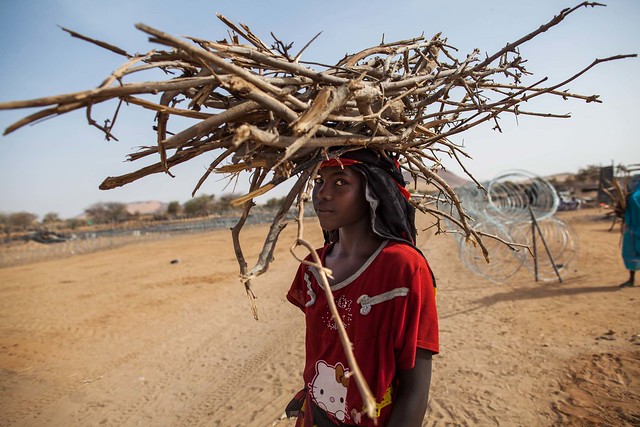
This entry documents the invisible labor in every meal across much of Africa: the collection of firewood. It archives not just the act, but the time lost, the body burdened, the fear endured, and the health sacrificed so that food can be cooked.
Sensory Archive: The Smell of Smoke, The Weight of Wood
- Smell: Smoke that burns eyes and irritates throat; dust and sweat during collection. :contentReference[oaicite:11]{index=11}
- Sound: Footsteps and breaking branches—then silence used as vigilance where leaving camp/settlement to collect firewood increases risk of sexual violence. :contentReference[oaicite:12]{index=12}
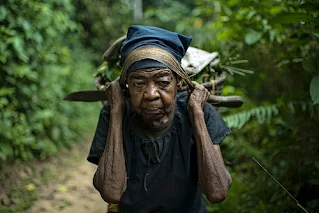
- Touch: Splintering bark; heavy loads carried on head/back with documented risk of muscle strain, spinal injury, fractures, pregnancy complications, and chronic pain. :contentReference[oaicite:13]{index=13}
- Taste: Firewood is “more than fuel,” shaping the taste/smell of staples; women link collection directly to cooking nsima. :contentReference[oaicite:14]{index=14}
- Fear: Documented danger on routes (animal + human predators) and documented patterns of assault during firewood collection in displacement/conflict settings. :contentReference[oaicite:15]{index=15}
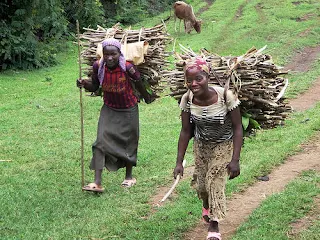
- Camaraderie: Group walking as safety and friendship—documented as “teenage friends” on the trek; firewood as a social practice within daily coping. :contentReference[oaicite:16]{index=16}
Sensory Testimony: Women Who Carry the Wood
Unlike institutional food systems, the sensory reality of firewood collection has been directly documented in women’s own words across multiple African regions. These testimonies appear in development studies, oral histories, and gender-based violence reports. What follows is a synthesis of those documented voices.
Smell: Smoke Before the Fire
Women consistently describe the smell of firewood labor beginning before cooking: dry dust lifted by footsteps, crushed leaves, sweat, and the sharp scent of green or resinous wood. In Ethiopia and Kenya, women collecting eucalyptus note the smoke as eye-burning and bitter. In refugee and peri-urban settings, women report smoke mixed with plastics or treated wood, producing nausea and headaches.
Touch: Weight, Grain, and Pain
Across regions, women describe the wood itself as abrasive, splintering, and unforgiving. Bark cuts the skin. The load presses into the crown of the head or the upper spine. Women speak of numb shoulders, burning muscles, and the slow reshaping of the body over years of carrying — “the back bends even when the load is gone.”
Sound: Silence as Warning
Testimony from conflict-affected areas describes a critical sensory shift: silence. Women report walking without speaking, listening for footsteps, breaking branches, or male voices. In these accounts, silence is fear. The absence of sound signals danger as much as its presence.
Taste: Dust, Thirst, and Smoke
Women frequently describe dust in the mouth, thirst during long walks, and the later taste of food cooked over the fire they gathered — smoky, sometimes acrid, sometimes comforting. The taste of the meal is inseparable from the labor that produced the flame.
Camaraderie: Walking Together
Despite danger and exhaustion, many women describe firewood collection as one of the few spaces of shared female presence. Walking in groups provides safety, conversation, song, and mutual vigilance. Friendships are formed on these paths. News is exchanged. For some, it is the only time they speak freely outside the home.
Source Basis: Synthesized from women’s testimonies documented by the World Health Organization, UN Women, Human Rights Watch, Practical Action, and regional ethnographic studies on fuelwood collection, energy poverty, and gender-based violence.
AFHA Evidentiary Note: This archive preserves women’s sensory descriptions as reported. Where language varies by region, shared sensory patterns are noted without collapsing local specificity.

Regional Comparison: Firewood Collection as Sensory Risk Infrastructure
| Region / Setting | What Women Say / What Is Documented | Primary Sensory Markers | Archive-Grade Source |
|---|---|---|---|
| Malawi (rural, Mount Mulanje area) | Women and girls trekking for hours; “It’s heavy”; danger on routes; “crocodiles” also coded as human predators. | Load pain; fear; distance; staples tied to fuel (nsima). | Pulitzer Center field reporting (direct quotes). :contentReference[oaicite:19]{index=19} |
| Sudan/Darfur (conflict + displacement) | Documented pattern: women and girls attacked/raped when leaving relative protection to collect firewood and other essentials. | Silence/vigilance; fear; route-risk. | Human Rights Watch documentation. :contentReference[oaicite:20]{index=20} |
| Refugee camps: Kakuma (Kenya) + Goudoubo (Burkina Faso) | Firewood embedded in camp economies and coping; explicitly linked to taste/smell of cooking cultures even when labelled “dirty” fuel. | Taste/smell of staples; soot/shame; scarcity. | Chatham House ethnographic research paper section on “Firewood.” :contentReference[oaicite:21]{index=21} |
| Cross-regional public health (general) | Documented acute symptoms (burning eyes, cough, irritation) + musculoskeletal injury risk from fuel carrying; women/children bear greatest burden. | Eye/throat burn; breath limitation; chronic pain. | WHO fact sheet + WHO health risks page. :contentReference[oaicite:22]{index=22} |
| Sudan (current conflict context) | UN Women notes everyday survival acts—including collecting firewood—carry risk of sexual violence. | Fear; constraint; “ordinary” tasks as danger zones. | UN Women press briefing remarks (2025). :contentReference[oaicite:23]{index=23} |

Time Poverty: The Hours That Disappear
Women and girls spend 20+ hours per week collecting firewood. That is time not spent in school, not spent resting, not spent with children, not spent building a business.
Comparison: A household with gas or electricity regains 3–4 hours each day. That is the difference between illiteracy and education, between exhaustion and energy, between vulnerability and safety.
Trauma & Health: The Body Pays
- Physical: Spinal injuries, pelvic damage, chronic respiratory disease. Cooking with firewood is equivalent to smoking 3–20 packs of cigarettes a day (WHO).
- Sexual Violence: Women searching in remote or conflict areas face rape, harassment, assault. The threat is a constant companion.
- Mental: Anxiety, hypervigilance, PTSD—the psychological tax of dangerous labor.

Environmental & Economic Reality
Over 80% of energy in African countries comes from wood. It is both an engine of survival and a source of deforestation, air pollution, and climate vulnerability.
The trade provides income for millions, but often under unsafe, exploitative conditions for women and girls.
Why Archive This?
Because food heritage is not just recipes. It is fuel, time, labor, and risk. To understand African foodways, you must understand the weight of the wood that cooks it—and the weight of the hours lost carrying it.
We preserve this so future generations know: the flavor of a meal is also the taste of the struggle to prepare it.
AFHA System Link: Fuel as Control
This record is structurally linked to AFG-UG-LUZIRA-001 — The Engineered Meal: Carceral Food Systems at Luzira Prison.
In domestic contexts, fuel scarcity manifests as time poverty and bodily risk. In carceral contexts, fuel is rationed, regulated, and weaponized as institutional control. In both systems, fire determines not only what is eaten, but who decides.
Fuel is the first ingredient in every meal. This record connects to a larger archive documenting African food as infrastructure. Explore African foodways →


