Posts

Showing posts from 2016
🌿 Share this page

Africa told through food, memory, and time.

African foods are systems of knowledge

The story of Sara Saartjie Baartman large butt, black female sexuality and body shape is still debated as empowerment vs exploitation entertainment.

Sarah Baartman was exhibited in human zoo's naked or scantily dressed throughout Britain, Paris, Ireland, and Belgium from 1810 to 1815 in cages alongside animals, in public places and rich clients’ private homes. She was pinched, poked made fun of, studied, sexualized, and ridiculed as part of exotic exhibitions in Europe.

The Hottentot Venus, Sarah Baartman was a South African Khoisan tribe woman from the Kalahari famous for the biggest butt the world has ever seen. Sarah Baartman became world famous as the most exotic of the four Hottentot Venuses paraded around Eroupe as well as a landmark court case.

Sara Baartman

Life, death and torture of African Hottentot Venus Sarah Baartman.

Treated inhumanly, the short life of the Hottentot Venus Sarah Baartman was one to be displayed and exhibited naked or scantily dressed at 225 Piccadilly in a cage on stage in London's Piccadilly Circus.

Unable to read or write, allegedly she signed a contract that she would receive half the profit. Other terms of her contract were that she would travel with Hendrik Cezar and Dunlop to England and Ireland to work as a domestic servant, and be exhibited for entertainment purposes could return to South Africa after five years.

She was put on display in 1810 at carnivals of human curiosities, live specimens and exotic exhibitions, Piccadilly Circus and freak shows in London and Paris, with crowds invited to look at her large booty and genitals. Britain's well to do society members gawked at, prodded and squeezed Sarahs so-called freakish human form which was paraded before them.

Sarah had a condition called Steatopygia that is a condition that produces a substantial amount of fat tissue on the buttocks and thighs. Steatopygia is common in the women of the Griqua Khoikhoi tribe which Sarah was born.

Life, death and torture of big booty African hottentot venus Sarah Baartman
Britain's well to do society members gawked at, prodded and squeezed Sarah behind while attending human zoo's.

Sarah's promoters nicknamed her the Hottentot Venus. Hottentot now seen as derogatory was used by white Europeans to describe the Khoi African peoples. Sarahs physical and economic exploitation became the rallying cry of abolitionists in London. The African Association also known as African Association for promoting the discovery of the interior of Africa was founded in 1788 and brought Baartmans case to court.

Baartman was the only Hottentot Venus whose case of exploration made its way through the courts. The law case was brought before the British Judiciary System in November 1810 were observers of the court case documented what they observed Baartman to go through day-to-day. Through this court case, today this is how the world able to trace her story in London and Paris.

Activists were appalled at Sarah's treatment and how the African women were portrayed as wild sexual creatures made shamed for having large bodies. Her employers were prosecuted for holding Sarah against her will, but not convicted, with Sarah herself testifying in their favor.

Sarahs show gradually lost its novelty and popularity among audiences in Paris and she went on tour around Britain and Ireland. A year before her death in 1814, Sarah worked for Reaux, an animal exhibitor in South Africa where she was exhibited in a cage alongside animals.

Born in South Africa's Eastern Cape in 1789, Sarah Baartman died on December 29, 1815, at the age of 26, but her exhibition continued. Baron Georges Cuvier was a French zoologist who established the sciences of comparative anatomy and paleontology. He and other medical scientists codified racial difference by studying, recording and drawing Sarah Baartmans’ genitals and buttocks.

Cuvier, a naturalist obtained Baartmans' remains from local police and dissected her body. He made a plaster cast of her body, pickled her brain and genitals and placed them into jars that were placed on display at the Musee de l'Homme Museum of Man until 1974.

In 1994, President Nelson Mandela requested that the French government return the remains of Sarah. The process took eight years but on March 6, 2002, Sarah was brought back home to South Africa. 

She was buried August 9, 2002, on Women’s Day at Hankey in the Eastern Cape Province. In Sarah's honor, South Africa's Eastern Cape Province Cacadu District was renamed the Sarah Baartman District in 2015.

Did you know? Born in 1789 and died in 1815, no photographs of Sarah Baartman, the Hottentot Venus exists, only drawings. Sarah may have died from the result of health problems due to suppossed alcoholism however her cause of death cannot be confirmed. No written recording of Sarah Baartman have been found., her voice and her own life story in her words were never written down.

The human trafficking and black exploitation story of Sara Saartjie Baartman life and death story continued the belief that black women are extraterrestrial sexual black nymphos because of large butts, the nature of black female sexuality and black female bodies today is still one of empowerment vs exploitation entertainment.

Did you know? In Paris on November 19, 1814 Sarah Baartman’s large backside inspired a one act Vaudeville play called the Hottentot Venus or the hatred of the Frenchwoman written by Thiaulon,Dartois, and Brasier where a bride-to-be wears a large wide triangular dress mimicking the wide hips of Baartman to keep the attention of her husbands-to-be wandering eyes.

The Missing Meal: Sara Saartjie Baartman's Untold Food Story

We know every cruel detail of how Sara Saartjie Baartman's body was displayed across Europe. We know the measurements, the stares, the objectification. Yet, for all this obsessive recording, history is silent on the most basic human detail: what did she eat?

What stews from her homeland in South Africa did she crave while in cold London and Paris? What grains—sorghum or maize—had fueled her strength? What wild greens or roasted meats were the tastes of her childhood, the very foods that built the body Europeans found so "fascinating"?

This is the great, unsettling absence. They documented her form but erased her sustenance. They were fascinated by the iron in her display cage, but showed no curiosity about the iron-rich foods that were part of her life. In reducing her to a spectacle, they stripped away the daily human reality of hunger, meals, memory, and the simple act of nourishment. Her story is a stark reminder that to truly see a person, you must ask not just what they looked like, but what fed them.

A Note on Dignity and Return

The story of Sara Saartjie Baartman represents one of the most painful chapters in the history of how people have been treated by institutions of science and display. For decades, her remains were held far from home, studied not as a person but as a specimen.

Today, this history is understood as a profound failure of respect and ethics. After years of advocacy by the South African government and the Khoisan community, her remains were finally returned to her homeland in 2002 and laid to rest with dignity. This act of repatriation was a crucial step toward healing.

Her legacy now informs vital, ongoing efforts in museums worldwide to ensure that human dignity, community voice, and ethical care guide the stewardship of collections. It is a reminder that behind every object—and every person once treated as one—is a full human story deserving of honor.

Top 20 Largest Countries in Africa: How Land Shapes Food & Farming

Top 20 Largest Countries in Africa: How Vast Landscapes Shape Food Cultures

Africa — often called the Cradle of Civilization — is the world’s second-largest continent by land area and population. This 2025 update ranks the Top 20 largest African countries by land size and explores how geography determines farming, traditional crops, and culinary traditions across the continent. From the wheat fields of Algeria to the cassava farms of the Congo, size matters in Africa's food story.

Map of Africa showing agricultural zones and largest countries

Africa’s vast landmass spans farming regions from desert oases to rainforest gardens.

Africa’s Largest Countries: Where Space Meets Food Production

African country (largest → smaller) Area (sq mi) Area (sq km) Food & Farming Notes
Algeria 919,5952,381,740 Wheat Belt Date Oases
Democratic Republic of the Congo (DRC) 905,5682,345,410 Cassava Heartland Rainforest Foods
Sudan 718,7231,861,484 Sorghum Plains Nile Irrigation
Libya 679,3621,759,540 Coastal Farming Desert Agriculture
Chad 495,7551,284,000 Millet Fields Lake Chad Fish
Niger 489,1911,267,000 Drought-Resistant Crops Traditional Grains
Angola 481,3541,246,700 Coffee Highlands Cassava Farms
Mali 478,7671,240,000 Ancient Grains Niger River Crops
South Africa 471,0111,219,912 Wine Regions Maize Belt
Ethiopia 435,1861,127,127 Coffee Birthplace Teff Farming
Mauritania 397,9551,030,700 Coastal Fisheries Nomadic Herding
Egypt 386,6621,001,450 Nile Valley Crops Ancient Bread Culture
Tanzania 364,900945,087 Spice Islands Banana Plantations
Nigeria 356,669923,768 Yam Capital Palm Oil Producer
Namibia 318,696825,418 Game Meat Arid Farming
Kenya 224,962582,650 Tea Highlands Vegetable Farms
Ghana 92,456239,460 Cocoa Leader Plantain Dishes
Madagascar 226,657587,040 Vanilla Islands Rice Terraces
Senegal 75,749196,190 Peanut Basin Coastal Cuisine
Cameroon 183,568475,440 Food Basket Diverse Crops
Morocco 172,414446,550 Olive Groves Spice Markets

How Land Area Influences African Food Systems

Africa's largest countries aren't just big on the map—their vast territories create unique food environments:

  • Space for Diversity: Countries like DRC and Sudan have room for multiple farming zones, from river valleys to highlands.
  • Traditional Farming: Vast areas in Mali and Niger preserve ancient grain varieties and herding traditions.
  • Transport Challenges: Getting food from remote farms to markets is a major issue in large countries like Angola and Chad.
  • Climate Zones: Algeria's size spans Mediterranean coastlines to Saharan oases, creating diverse food baskets.
  • Food Security: Large land area doesn't always mean food abundance—distribution and water access matter more.

Agricultural Patterns in Africa's Largest Nations

River-Based Farming: The Nile (Egypt, Sudan), Niger (Mali, Niger), and Congo rivers support intensive agriculture in otherwise dry regions.

Rainforest Harvest: DRC's vast forests provide wild foods, medicinal plants, and shifting cultivation areas.

Savanna Grains: The Sahel belt across Chad, Niger, and Mali is the heartland of millet and sorghum farming.

Coastal Fisheries: Mauritania, Namibia, and South Africa's long coastlines support major fishing industries.

Highland Crops: Ethiopia and Kenya's elevation allows coffee, tea, and temperate vegetable farming.

Frequently Asked Questions About Africa's Land and Food

Does larger land area mean more food production in Africa?

Not necessarily. While large countries like DRC and Sudan have agricultural potential, factors like water access, soil quality, and infrastructure matter more than sheer size. Algeria is Africa's largest country but imports much of its food due to desert conditions.

Which large African country is most self-sufficient in food?

Ethiopia has made significant progress with its diverse climate zones allowing multiple harvests. South Africa is also a major food producer and exporter within the continent.

How does land size affect traditional cooking in Africa?

Vast countries develop regional cuisines: coastal dishes in Libya's Mediterranean north versus Saharan nomadic foods in the south. Nigeria's size creates distinct yam-based dishes in the east, millet in the north, and seafood in the south.

What traditional farming methods work best in large, dry countries?

Countries like Niger and Chad use drought-resistant millet varieties, nomadic pastoralism, and oasis gardening. Sudan utilizes flood retreat farming along the Nile.

Which large African countries are leading in organic farming?

Tanzania and Ethiopia have growing organic sectors, particularly for coffee and spices. Uganda (though not in top 20 by size) is a leader in organic agriculture.

Final Thought: Africa's largest countries tell a story of agricultural adaptation—from the irrigated fields along ancient rivers to the shifting cultivation of vast rainforests. Their food traditions are as diverse as their landscapes, proving that in Africa, land size shapes what's on the plate.

Documentation: Ethnobotanical Myth of the First Banana Tree (Musa spp.) | African Foodways Heritage Archive

Documentation: Ethnobotanical Myth of the First Banana Tree (Musa spp.) – Folklore as a Vessel for Foodways Knowledge

Archive Entry: African Foodways Heritage Archive
Primary Subject: Banana (Musa spp.) Origin Folktale
Analysis Frame: Ethnobotany & Narrative Pedagogy
Core Concept: Myth as Encoded Agricultural Knowledge
Key Characters: Okown (Ancestor/Hunter), Uke (God of Seeds)
Narrative Function: Explains Domestication, Teaches Reciprocity, Integrates Staple Crop
Originally Documented: November 2016 | AFHA Compiled: January 2026

The Folktale as Pedagogical Technology: African folktales are often dismissed as mere "myths" or children's stories. This archive contends they are sophisticated pedagogical technologies for transmitting survival-critical knowledge across generations without written texts. The "First Banana Tree" story is a prime example. It is not a fictional account of creation but a cultural memory and instruction manual that packages information on plant propagation, ecological ethics, and the historical integration of a transformative new food source into society.
Artistic collage depicting elements of the banana folktale with a central tree, a crescent moon, and a figure
Figure 1. Narrative art depicting the folktale. Visual storytelling reinforces the oral narrative, embedding the myth, its characters (Okown, Uke), and its moral and botanical lessons into communal memory and identity.

Narrative Analysis: Decoding the Folktale's Layers of Meaning

Layer 1: The Surface Narrative (The Story)

  • Plot: Hungry hunter (Okown) finds divine seeds, returns them, is rewarded with seeds that grow into the first banana tree.
  • Explicit Moral: Honesty and respect for the property of spirits/gods are rewarded.
  • Character Role: Okown represents humanity; Uke represents the natural/divine world's generative force.
  • Outcome: Humanity receives a perennial, bountiful food source as a direct result of ethical conduct.

Layer 2: The Botanical & Agricultural Subtext (The Instruction)

  • The "Golden Seeds": A narrative representation of banana rhizomes (corms) or suckers—the actual means of propagation for cultivated, seedless bananas. The story correctly emphasizes propagation via planting material, not true seeds.
  • "Shaped like the sliver of the moon": A direct observational metaphor for the crescent shape of a banana fruit, linking the planting material to its eventual yield.
  • Planting in a Garden: Signals the shift from foraging to deliberate cultivation and domestication.
  • Rapid Growth & Beauty: Highlights the banana plant's fast growth, high yield, and aesthetic appeal—key attributes for farmers adopting a new crop.

Layer 3: The Cultural-Ecological Philosophy (The Worldview)

  • Principle of Reciprocity: Humans do not take from nature without giving (respect, honesty). The gift of food is conditional on ethical behavior.
  • Anthropomorphism of Nature: Uke, the "God of Seeds," personifies the generative, uncontrollable force of the forest. Engagement requires ritualized respect.
  • Explaining Innovation: The myth provides a sacred origin for a crop that was likely introduced or significantly improved through trade or selective cultivation, integrating it into the existing cosmological order.
  • Memory of Change: The story preserves the cultural memory of a time before bananas were ubiquitous, marking their adoption as a significant, divine event.
Symbolic artwork titled 'Banana God Myth' featuring a stylized face with banana tree and crescent moon motifs
Figure 2. Symbolic representation "Banana God Myth." This modern artwork demonstrates the enduring power of the narrative, visually encoding the folktale's core symbols—the divine, the crescent, the tree—into a contemporary icon, showing the myth's active life in cultural expression.

Contextual Documentation: The Banana in African Foodways

Botanical Reality vs. Mythic Representation

The folktale cleverly navigates the actual botany of the cultivated banana:

  • Seedlessness: Edible bananas (Musa spp., primarily hybrids in the AAA group) are mostly sterile and seedless. They are propagated vegetatively via suckers or rhizome pieces—exactly what the "golden seeds" metaphorically represent.
  • Origin & Diffusion: Bananas were domesticated in Southeast Asia and reached Africa via ancient trade routes across the Indian Ocean (likely 2000-3000 years ago). The folktale provides an indigenous origin story for this introduced crop, a common narrative strategy to claim and naturalize foreign elements.
  • Agroecological Fit: Bananas thrived in Africa's tropical climates, offering a reliable, year-round source of carbohydrates from a perennial plant, complementing annual grain crops.

Culinary and Economic Significance

The banana's value, hinted at by the tree's "beauty" and bounty, is realized in diverse applications:

  • Staple Food: In regions like the African Great Lakes (Uganda, Rwanda, Burundi, parts of DRC), bananas (specically East African Highland bananas, a cooking type) are a primary staple, consumed as matoke (steamed and mashed).
  • Dual Purpose: Distinction between starchy cooking bananas/plantains and sweet dessert bananas. Both are vital for nutrition and cuisine.
  • Fermentation: Bananas are used to make beverages like banana beer (urwagwa) and wine, important in social and ritual contexts.
  • Economic Role: A crucial smallholder crop for subsistence and local markets; dessert bananas are a major export commodity for countries like Côte d'Ivoire, Cameroon, and Ghana.

The Folktale as a Living Document in the AFHA

Preserving the Narrative Integrity

The AFHA records the folktale in its presented form, respecting its structure as a complete oral text:

African Folktale Story of Earth's First Banana Tree

As the Ancestors say, Okown was wandering the forest in search of food for his family when he came across a bag of golden seeds shaped like the sliver of the moon.

Uke, the God of seeds, was engaged in planting trees and did not notice he was missing a bag of seeds. Despite being hungry, instead of stealing the golden seeds, Okown returned them to Uke.

Uke rewarded him for his honesty with a handful of golden seeds. Okown went home and planted the seeds in his garden that grew into a beautiful, tall banana tree with shapes resembling the sliver of the moon and the color of the sun.

— Recorded Oral Narrative, AFHA Source

Analytical Conclusion: Why This Story Matters to Foodways

This folktale does more than explain a plant's origin. It performs essential cultural work:

  1. It Legitimizes a Staple Crop: By giving the banana a divine origin, it elevates the plant from a mere food to a sacred gift, ensuring its cultural importance and careful stewardship.
  2. It Encodes Propagation Knowledge: It correctly instructs that bananas are grown from planting material ("seeds" you put in a garden), not from wild forest foraging.
  3. It Teaches Sustainable Ethics: It establishes a paradigm of reciprocity with the environment: take only what is given, and act with honesty towards the natural world.
  4. It Adapts to Change: It demonstrates how societies use narrative to absorb and make sense of agricultural innovations, weaving new elements into the fabric of traditional knowledge.

Documented Method: Analyzing Food-Centric Folklore

This entry employs a standard AFHA methodology for analyzing food-related myths and folktales:

  1. Textual Preservation: Record the narrative as faithfully as possible, noting source context.
  2. Structural Deconstruction: Identify core plot, characters, conflict, and resolution.
  3. Ethnobotanical Decoding: Interrogate the description of the plant, its origin, and its properties against known botanical and archaeological data.
  4. Pedagogical Function Identification: Determine what practical knowledge (agricultural, ecological, culinary) is being transmitted.
  5. Cultural Integration Analysis: Examine how the story integrates the food item into the wider cosmology, social values, and historical memory of the community.

Archive Note: This method reveals that stories like these are not quaint fictions but active components of a living, adaptive knowledge system essential for food security and cultural continuity.


This entry forms part of the African Foodways Heritage Archive's documentation of oral tradition as a primary repository of agricultural and ecological knowledge. The folktale of the first banana tree is archived here not as a relic of the past, but as a dynamic case study. It demonstrates how African societies have historically used narrative to domesticate knowledge alongside domesticating plants—turning the practicalities of propagation and the ethics of ecology into stories that endure, educate, and ensure that the meaning of food is never separated from its cultivation.

Documentation: Sudanese Moukhbaza (Banana & Chili Paste) | African Foodways Heritage Archive

Documentation: Sudanese Moukhbaza – The Sensory Duality of Eastern Sudanese Cuisine

Archive Entry: African Foodways Heritage Archive
Primary Subject: Moukhbaza (موخبازة)
Dish Type: Condiment / Side Dish (Sweet & Spicy Paste)
Core Concept: Sensory & Cultural Duality
Primary Region: Eastern Sudan (Red Sea State, Kassala)
Key Ingredients: Very ripe bananas, dried chili peppers, lemon juice
Key Accompaniment: Kisra (fermented sorghum flatbread)
Originally Documented: November 2016 | AFHA Compiled: January 2026

The Duality Principle: Moukhbaza is built upon a foundational and deliberate contrast. It pairs the creamy, saccharine sweetness of overripe bananas with the piercing, aromatic heat of dried chilies. This is not a fusion but a juxtaposition—the ingredients are combined on the plate yet remain distinct to the palate. This sensory duality mirrors the dish's cultural position: it is a hyper-local identifier for Eastern Sudan within the nation's diverse culinary map, and a product of the broader Red Sea trade sphere that connected Africa with the Arabian Peninsula and the Mediterranean.
A bowl of yellow mashed banana paste topped with red dried chili slivers
Figure 1. The prepared Moukhbaza dish. The visual composition directly communicates its essence: a uniform, bright yellow base of mashed banana punctuated by a scattered layer of vibrant red dried chili, a perfect prelude to the sweet-spicy experience.

Tripartite Analysis: Sensory, Geographic, and Social Dimensions

1. Sensory & Culinary Dimension

  • Core Contrast: Sweet (banana) vs. Spicy (chili). Each bite activates different taste receptors sequentially or simultaneously.
  • Textural Role: The creamy, smooth banana paste acts as a vehicle and coolant for the brittle, intense chili flakes.
  • Ingredient State: Depends on peak-ripeness (bananas for maximum sugar) and preservation (dried chilies for concentrated capsaicin and flavor).
  • Chemical Interaction: The capsaicin in chilies binds to pain receptors (TRPV1), while the sugars in banana may provide a momentary mitigating effect, creating a dynamic, "conversational" flavor profile in the mouth.

2. Geographic & Historical Dimension

  • Regional Signature: Primarily associated with the east, particularly among Beja communities and in cities like Port Sudan and Kassala.
  • Cross-Red Sea Influence: The use of chili pepper points to introductions via trade from the Mediterranean/Arabian world during Ottoman influence, while the banana's ultimate origin is Southeast Asia (via earlier trade).
  • Neighborly Influence: Acknowledged culinary kinship with Ethiopia, which shares a tradition of spicy condiments (e.g., awaze) and fermented flatbreads (injera / kisra).
  • Marker of Identity: Within Sudan, claiming Moukhbaza as a favorite instantly signals an Eastern Sudanese affiliation.

3. Social & Ritual Dimension

  • Communal Context: Served on the large, shared communal tray (ṣaḥn) among an array of stews, salads, and breads.
  • Functional Role: Acts as a condiment or side relish, not a main. It is taken in small amounts with pieces of kisra to complement savory dishes.
  • Ritual of Dining: Its preparation (drying chilies, mashing ripe fruit) and presentation reinforce traditional foodways knowledge and the aesthetics of the shared meal.
  • Conversational Food: The dramatic flavor combination sparks comment and sharing among diners, enhancing social bonding.

Documentation: Traditional Preparation of Moukhbaza

Dish Documentation: Sudanese Moukhbaza

Culinary Context: A staple condiment of Eastern Sudanese daily and festive meals.
Primary Function: To provide a sweet, cooling, and spicy counterpoint to savory grain-based main dishes.
Key Technique: Sun-drying or slow-oven drying of chili peppers.
Preparation: 20 minutes (active)
Drying Time: 4+ hours (passive, can be done in advance)
Yield: Approximately 2 cups (serves 4-6 as part of a spread)

Ingredients & Ethnographic Notes

  • Very Ripe Bananas (4 large): Must be extremely ripe (black-speckled skin) to achieve the necessary high sugar content and soft, mashable texture. This emphasizes using abundance at peak flavor, reducing waste.
  • Fresh Hot Chili Peppers (5 whole): Typically local varieties like bird's eye. Drying transforms them, concentrating heat and developing nuanced, smoky-sweet flavors beyond mere pungency.
  • Lemon Juice (2 tsp): Serves a dual purpose: 1) preventing oxidation (browning) of the banana paste to maintain appetizing color; 2) adding a faint acidic note that brightens the overall sweetness.

Method as Cultural Practice

  1. Preserve the Chili: Slice chilies into slivers and dry thoroughly (sun or low oven). This step is emblematic of traditional food preservation in a hot climate, ensuring a year-round supply of critical flavoring agents.
  2. Create the Base: Mash peeled, overripe bananas into a smooth paste. The action is simple but specific—the goal is a cohesive, spreadable consistency.
  3. Stabilize and Brighten: Mix in lemon juice. This small step reflects practical kitchen chemistry learned through tradition.
  4. Present the Duality: Mound the banana paste in a bowl and blanket it generously with dried chili slivers. The presentation is symbolic: the two elements are combined but visually distinct, telling the story of the dish before tasting.
  5. Serve Communally: Place on the ṣaḥn alongside kisra bread, stews (mullah), and salads. Eating entails tearing a piece of kisra, using it to scoop a small amount of paste with chili, and combining it with other dishes on the plate.

Note on Adaptation & Context: This recipe captures the essential, minimalist preparation. In a home setting, the ratio of chili to banana can be adjusted per family preference. The drying method (sun vs. oven) is adaptable to environment, but sun-drying is the traditional and most flavor-respected technique, as shown in Figure 2.

A tray full of fresh red chili peppers drying in the sun under a mesh screen
Figure 2. Sun-drying chili peppers, a cornerstone technique. This preservation method harnesses the local climate, intensifies flavor, and represents a self-sufficient, seasonal approach to food preparation central to Sudanese culinary knowledge.

Broader Context within Sudanese and Red Sea Foodways

Position within the Sudanese Meal Structure

Moukhbaza is one component in a highly structured culinary system:

  • The Communal Tray (Ṣaḥn): The center of dining. It holds a carbohydrate base (rice, kisra), one or more stews (mullah or shorba), salads (salata), and condiments like Moukhbaza and shatta (chili paste).
  • Flavor Balancing Act: Dishes are designed to complement each other. The strong, salty, savory notes of a meat stew are balanced by the fresh crunch of a cucumber salad and the sweet-heat of Moukhbaza.
  • The Role of Kisra: The fermented sorghum flatbread is more than an utensil; its slight sourness provides another flavor layer that interacts with both the stew and the Moukhbaza.

As a Product of Trade and Cross-Cultural Exchange

The ingredients tell a history of movement:

  • Chili Peppers (Capsicum spp.): Introduced to the Old World from the Americas after the 15th century. Their integration into Sudanese cuisine, especially in the eastern trade ports, illustrates how new world crops were rapidly adopted and localized along existing spice trade routes.
  • Bananas (Musa spp.): Domesticated in Southeast Asia, they reached East Africa via Indian Ocean trade millennia ago. Their use in a savory condiment highlights a uniquely African culinary application distinct from dessert uses.
  • Lemon/Citrus: Likely introduced from the Middle East or Asia. Its use as an anti-browning agent shows a practical understanding of food chemistry developed within this specific culinary tradition.

Significance for the AFHA: Documenting Hyper-Local Identity

Why Moukhbaza is an Archival Priority

This dish represents a critical category for food heritage documentation:

  • Marker of Micro-Regionality: It counters homogenized notions of "Sudanese cuisine" by highlighting a dish that is passionately associated with one specific region within the country.
  • Example of Sensory Coding: It demonstrates how a culture codifies a specific, complex sensory experience (sweet-spicy contrast) into a standard, replicable food form.
  • Living Link to Practice: Its preparation involves traditional preservation (drying) and communal serving rituals, making it a vessel for transmitting non-written knowledge.
  • Adaptability & Resilience: The recipe is simple and adaptable (oven vs. sun drying) but insists on core principles (very ripe fruit, dried chilies), showing how tradition maintains identity while allowing for practical adjustment.

Documented Technique: The Science and Tradition of Sun-Drying Chilies

The drying of chilies for Moukhbaza is not merely dehydration; it is a flavor-transforming process:

  1. Concentration: Removal of water concentrates capsaicinoids (heat compounds) and flavor molecules, increasing pungency and depth per gram.
  2. Flavor Development: Slow, low-heat drying (especially sun-drying) allows for enzymatic and chemical reactions that can develop raisin-like, smoky, or earthy secondary flavors not present in the fresh pepper.
  3. Preservation for Food Security: It enables the use of a seasonal, perishable ingredient year-round, a critical strategy in subsistence economies.
  4. Cultural Specificity: The specific variety of chili chosen and the degree to which it is dried (leathery vs. brittle) contribute to the regional signature of the final dish.

Technical Note: Sun-drying under a mesh screen, as shown in Figure 2, allows airflow while protecting from insects and debris, representing an optimal low-tech solution developed over generations.


This entry forms part of the African Foodways Heritage Archive's documentation of regional culinary signatures and sensory food cultures. Sudanese Moukhbaza is archived here as a definitive case study in how a seemingly simple combination of ingredients can embody a complex web of meaning: geographic identity, historical trade, sensory philosophy, and social ritual. By preserving its specific preparation and contextualizing its role, the AFHA ensures that the distinctive voice of Eastern Sudan's cuisine remains audible within the grand chorus of African food heritage.

The African Gourmet Foodways Archive: The Weight of Firewood

The African Gourmet Foodways Archive

Entry: The Weight of Firewood — Time, Trauma, and the Hearth

Collecting Firewood in Africa
Before sunrise. The search begins. Miles walked for a few branches.

This entry documents the invisible labor in every meal across much of Africa: the collection of firewood. It archives not just the act, but the time lost, the body burdened, the fear endured, and the health sacrificed so that food can be cooked.

Sensory Archive: The Smell of Smoke, The Weight of Wood

  • Smell: Smoke that burns eyes and irritates throat; dust and sweat during collection. :contentReference[oaicite:11]{index=11}
  • Sound: Footsteps and breaking branches—then silence used as vigilance where leaving camp/settlement to collect firewood increases risk of sexual violence. :contentReference[oaicite:12]{index=12}
  • Touch: Splintering bark; heavy loads carried on head/back with documented risk of muscle strain, spinal injury, fractures, pregnancy complications, and chronic pain. :contentReference[oaicite:13]{index=13}
  • Taste: Firewood is “more than fuel,” shaping the taste/smell of staples; women link collection directly to cooking nsima. :contentReference[oaicite:14]{index=14}
  • Fear: Documented danger on routes (animal + human predators) and documented patterns of assault during firewood collection in displacement/conflict settings. :contentReference[oaicite:15]{index=15}
  • Camaraderie: Group walking as safety and friendship—documented as “teenage friends” on the trek; firewood as a social practice within daily coping. :contentReference[oaicite:16]{index=16}

Sensory Testimony: Women Who Carry the Wood

Unlike institutional food systems, the sensory reality of firewood collection has been directly documented in women’s own words across multiple African regions. These testimonies appear in development studies, oral histories, and gender-based violence reports. What follows is a synthesis of those documented voices.

Smell: Smoke Before the Fire

Women consistently describe the smell of firewood labor beginning before cooking: dry dust lifted by footsteps, crushed leaves, sweat, and the sharp scent of green or resinous wood. In Ethiopia and Kenya, women collecting eucalyptus note the smoke as eye-burning and bitter. In refugee and peri-urban settings, women report smoke mixed with plastics or treated wood, producing nausea and headaches.

Touch: Weight, Grain, and Pain

Across regions, women describe the wood itself as abrasive, splintering, and unforgiving. Bark cuts the skin. The load presses into the crown of the head or the upper spine. Women speak of numb shoulders, burning muscles, and the slow reshaping of the body over years of carrying — “the back bends even when the load is gone.”

Sound: Silence as Warning

Testimony from conflict-affected areas describes a critical sensory shift: silence. Women report walking without speaking, listening for footsteps, breaking branches, or male voices. In these accounts, silence is fear. The absence of sound signals danger as much as its presence.

Taste: Dust, Thirst, and Smoke

Women frequently describe dust in the mouth, thirst during long walks, and the later taste of food cooked over the fire they gathered — smoky, sometimes acrid, sometimes comforting. The taste of the meal is inseparable from the labor that produced the flame.

Camaraderie: Walking Together

Despite danger and exhaustion, many women describe firewood collection as one of the few spaces of shared female presence. Walking in groups provides safety, conversation, song, and mutual vigilance. Friendships are formed on these paths. News is exchanged. For some, it is the only time they speak freely outside the home.

Source Basis: Synthesized from women’s testimonies documented by the World Health Organization, UN Women, Human Rights Watch, Practical Action, and regional ethnographic studies on fuelwood collection, energy poverty, and gender-based violence.

AFHA Evidentiary Note: This archive preserves women’s sensory descriptions as reported. Where language varies by region, shared sensory patterns are noted without collapsing local specificity.

Firewood collection by women in Lukolela, DRC
Balance on rough terrain. Every meal has this physical cost.

Regional Comparison: Firewood Collection as Sensory Risk Infrastructure

Region / Setting What Women Say / What Is Documented Primary Sensory Markers Archive-Grade Source
Malawi (rural, Mount Mulanje area) Women and girls trekking for hours; “It’s heavy”; danger on routes; “crocodiles” also coded as human predators. Load pain; fear; distance; staples tied to fuel (nsima). Pulitzer Center field reporting (direct quotes). :contentReference[oaicite:19]{index=19}
Sudan/Darfur (conflict + displacement) Documented pattern: women and girls attacked/raped when leaving relative protection to collect firewood and other essentials. Silence/vigilance; fear; route-risk. Human Rights Watch documentation. :contentReference[oaicite:20]{index=20}
Refugee camps: Kakuma (Kenya) + Goudoubo (Burkina Faso) Firewood embedded in camp economies and coping; explicitly linked to taste/smell of cooking cultures even when labelled “dirty” fuel. Taste/smell of staples; soot/shame; scarcity. Chatham House ethnographic research paper section on “Firewood.” :contentReference[oaicite:21]{index=21}
Cross-regional public health (general) Documented acute symptoms (burning eyes, cough, irritation) + musculoskeletal injury risk from fuel carrying; women/children bear greatest burden. Eye/throat burn; breath limitation; chronic pain. WHO fact sheet + WHO health risks page. :contentReference[oaicite:22]{index=22}
Sudan (current conflict context) UN Women notes everyday survival acts—including collecting firewood—carry risk of sexual violence. Fear; constraint; “ordinary” tasks as danger zones. UN Women press briefing remarks (2025). :contentReference[oaicite:23]{index=23}
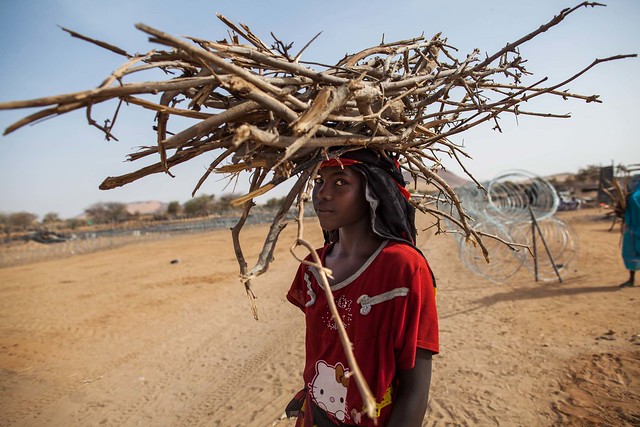
Woman carrying firewood in Segou, Mali
The walk home. The heaviest part—physically and mentally.

Time Poverty: The Hours That Disappear

Women and girls spend 20+ hours per week collecting firewood. That is time not spent in school, not spent resting, not spent with children, not spent building a business.

Comparison: A household with gas or electricity regains 3–4 hours each day. That is the difference between illiteracy and education, between exhaustion and energy, between vulnerability and safety.

Trauma & Health: The Body Pays

  • Physical: Spinal injuries, pelvic damage, chronic respiratory disease. Cooking with firewood is equivalent to smoking 3–20 packs of cigarettes a day (WHO).
  • Sexual Violence: Women searching in remote or conflict areas face rape, harassment, assault. The threat is a constant companion.
  • Mental: Anxiety, hypervigilance, PTSD—the psychological tax of dangerous labor.
Bundles of eucalyptus branches in Addis Ababa
Urban reliance. Woodfuel is not only rural. Cities run on it too.

Environmental & Economic Reality

Over 80% of energy in African countries comes from wood. It is both an engine of survival and a source of deforestation, air pollution, and climate vulnerability.

The trade provides income for millions, but often under unsafe, exploitative conditions for women and girls.

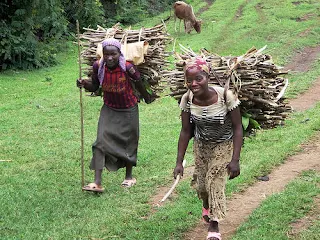
Collecting firewood in Jinka, Southern Ethiopia
Generational transmission. Young girls learn the labor—and the time poverty.
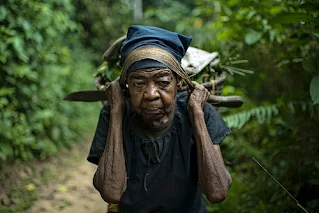
Elderly woman bringing firewood to Masako, DRC
A lifetime of carrying. The body remembers even when the mind tries to forget.

Why Archive This?

Because food heritage is not just recipes. It is fuel, time, labor, and risk. To understand African foodways, you must understand the weight of the wood that cooks it—and the weight of the hours lost carrying it.

We preserve this so future generations know: the flavor of a meal is also the taste of the struggle to prepare it.

Fuel is the first ingredient in every meal. This record connects to a larger archive documenting African food as infrastructure. Explore African foodways →


Curated by: The African Gourmet Foodways Archive

Source: Original article on the burdens of firewood collection in Africa.

Preservation Date: 2025 | License: CC BY-NC-SA 4.0

Kisra (Fermented Sorghum Flatbread) – Traditional Sudanese Method with Cross-Cultural Analysis

Documentation: Kisra (Sudanese Fermented Flatbread) – Traditional Method and Comparative Analysis with Korean Fermentation Traditions

Archive Entry: African Foodways Heritage Archive
Primary Subject: Kisra (Fermented Sorghum Flatbread)
Technical Focus: Lactic Acid Fermentation of Cereal Batter
Comparative Analysis: Sudanese vs. Korean Fermentation Applications
Key Microbiological Process: Wild Yeast & LAB Fermentation
Culinary Region: Sudan (with cross-cultural reference to Korea)
Originally Documented: September 2016 | AFHA Compiled: January 2026

The Fermentation Paradox: Kisra represents a sophisticated traditional food technology that harnesses uncontrolled environmental microbiology to create predictable, safe, and nutritious results. Unlike Western breadmaking that typically isolates and controls specific yeast strains, traditional Kisra fermentation relies on complex microbial communities native to the environment and ingredients, creating a product that is simultaneously ancient in method and advanced in its understanding of microbial ecology.
Traditional Kisra preparation showing fermented batter technique
Figure 1. Kisra fermentation process. The image captures the traditional method where sorghum flour batter undergoes 24-48 hours of natural fermentation, developing bubbles from microbial activity. This lactic acid fermentation not only leavens the bread but also predigests complex carbohydrates, increases bioavailability of nutrients, and creates characteristic tangy flavor.

Tripartite Analysis: Understanding Kisra Fermentation

1. Scientific & Microbiological Basis

  • Fermentation Type: Mixed lactic acid fermentation with wild yeast activity
  • Primary Microbes: Lactobacillus species (LAB) and environmental yeasts
  • Chemical Process: LAB convert carbohydrates to lactic acid, lowering pH (typically to 3.8-4.2), which preserves batter and creates tangy flavor
  • Leavening Mechanism: Wild yeasts produce CO₂, creating characteristic bubbles and light texture
  • Nutritional Enhancement: Fermentation breaks down phytic acid, increasing mineral bioavailability; produces B vitamins

2. Traditional Sudanese Context

  • Historical Role: Daily staple bread in Sudan for centuries, particularly in regions where sorghum is primary grain
  • Sorghum Adaptation: Developed specifically for sorghum (Sorghum bicolor), which lacks gluten and requires different treatment than wheat
  • Culinary Function: Served as edible utensil for scooping stews (mullah, bamia, shorba)
  • Social Significance: Prepared daily in many households; represents continuity of traditional food knowledge
  • Practical Benefits: Fermentation extends shelf life in hot climate; improves digestibility of sorghum

3. Cross-Cultural Fermentation Analysis

  • Shared Principle: Both Sudanese and Korean traditions utilize lactic acid bacteria (LAB) for preservation and flavor development
  • Divergent Application:
    • Sudanese Approach: Ferments the bread vehicle itself (Kisra batter)
    • Korean Approach: Ferments flavor components (kimchi, doenjang, gochujang) added to other foods
  • Cultural Logic: Each approach reflects culinary system priorities—Sudanese focus on transforming staple grain, Korean focus on creating versatile flavor foundations
  • Nutritional Outcome: Both introduce probiotics and enhance nutrient bioavailability through fermentation

Comparative Cultural Analysis: Fermentation Approaches

Sudanese vs. Korean Fermentation Traditions

Aspect Sudanese Kisra Fermentation Korean Fermentation Tradition
Primary Substrate Sorghum flour batter Vegetables (kimchi), soybeans (doenjang), chili (gochujang)
Fermentation Goal Create edible staple with improved nutrition Create flavor foundations for meal composition
Microbial Community Wild environmental LAB + yeasts Often starter-influenced but includes environmental microbes
Timeframe 24-48 hours (relatively short) Days to years (variable by product)
Culinary Role Central starch component of meal Flavoring components accompanying rice/starch
Nutritional Focus Carbohydrate digestion, mineral availability Vegetable preservation, probiotic diversity
Cultural Significance Daily sustenance, traditional continuity National identity, seasonal rhythm (kimjang)

Shared Wisdom Across Cultures

Despite different applications, both traditions demonstrate sophisticated understanding of:

  • Microbial Ecology: Harnessing local microbial communities for predictable transformation
  • Food Preservation: Using fermentation to extend food availability beyond harvest
  • Nutritional Optimization: Enhancing nutrient bioavailability through microbial predigestion
  • Flavor Development: Creating complex umami and sour notes through fermentation byproducts
  • Food Safety: Lowering pH to inhibit pathogens while allowing beneficial microbes to thrive

Technique Documentation: Traditional Kisra Preparation

Method: Traditional Kisra (Fermented Sorghum Flatbread)

Culinary Context: Daily staple bread in Sudanese cuisine
Fermentation Principle: Lactic acid bacteria + wild yeast natural fermentation
Critical Factors: Sorghum quality, water ratio, temperature, fermentation time
Active Preparation: 15 minutes
Fermentation Time: 24-48 hours
Cooking Time: 20 minutes
Yield: 8-10 sheets (serves 4-6)

Ingredients & Technical Rationale

  • Sorghum Flour (2 cups): Traditional grain; naturally gluten-free, rich in antioxidants and resistant starch. Must be finely milled for proper batter consistency.
  • Water (3-4 cups): Creates pourable batter. Ratio critical—too thick prevents proper fermentation and spreading; too thin yields fragile bread.
  • Fermentation Agent (¼ cup starter or ½ cup yogurt): Inoculates batter with LAB. Traditional method uses previous batch ("back-slopping"); modern adaptation uses commercial starters.
  • Salt (½ tsp): Regulates fermentation speed, enhances flavor, strengthens batter structure.

Step-by-Step Process with Microbial Notes

  1. Batter Creation: Mix sorghum flour and water to thin, pourable consistency. This high hydration allows microbial movement and gas diffusion throughout batter.
  2. Inoculation: Add starter culture. This introduces established microbial community, reducing fermentation time compared to purely wild fermentation.
  3. Primary Fermentation: Cover with breathable cloth (allows gas exchange while protecting from contaminants). Ferment at 20-25°C (68-77°F) for 24-48 hours. Visual indicators: surface bubbles, slight rise, tangy aroma. pH drops to 3.8-4.2.
  4. Batter Assessment: Properly fermented batter shows active bubbling, has pleasantly sour aroma (not putrid), and pours easily. Over-fermentation produces excessive sourness and weakened structure.
  5. Cooking Technique: Heat specialized Kisra pan or non-stick skillet. Use curved utensil to spread batter in thin, even layer—traditional spreading motion creates characteristic texture.
  6. Cook Single-Sided: Cook 60-90 seconds until edges lift and surface sets. Unlike many flatbreads, Kisra is traditionally cooked on one side only, preserving moist interior texture.
  7. Stacking Method: Remove and stack while warm. Stacking creates steam that keeps sheets pliable for serving.

Traditional Serving Context

In Sudanese Meals: Served warm as edible utensil for scooping stews. Typically accompanies:

  • Mullah (meat or vegetable stew)
  • Bamia (okra stew)
  • Shorba (lentil soup)
  • Ful Medames (stewed fava beans)
The tangy flavor of Kisra balances rich, savory stews while its texture allows effective scooping.

Cross-Cultural Culinary Applications

Comparative Serving Approaches

Traditional Sudanese Context

  • Primary Function: Edible utensil and starch base for stew-based meals
  • Meal Structure: Kisra + stew + optional fresh vegetables = complete meal
  • Cultural Practice: Often eaten communally from shared dish, using Kisra to scoop stew
  • Nutritional Complement: Sorghum provides complex carbohydrates and fiber to balance protein-rich stews

Korean-Inspired Adaptations (Conceptual Exploration)

While not traditional, examining how Kisra might interface with Korean flavors illustrates different culinary approaches to fermented components:

  • Flavor Philosophy Contrast:
    • Kisra as Vehicle: Fermented bread carries other foods
    • Korean Ferments as Accents: Fermented condiments flavor neutral starch (rice)
  • Potential Cross-Cultural Pairings (Conceptual):
    • Kisra as wrap for Korean BBQ, where its tang complements sweet-savory marinades
    • Kisra served with kimchi, exploring contrast between batter fermentation and vegetable fermentation
    • Using Kisra in place of rice with doenjang-based stews
  • Culinary Insight: Such conceptual pairings highlight how different cultures allocate fermentation effort—either to the staple itself (Sudan) or to flavor components added to staples (Korea).

Modern Nutritional Appreciation

  • Probiotic Benefits: Both traditions deliver live beneficial bacteria through different dietary vectors
  • Gluten-Free Alternative: Traditional sorghum-based Kisra offers naturally gluten-free fermented bread option
  • Prebiotic Content: Sorghum provides resistant starch that feeds beneficial gut bacteria
  • Synbiotic Potential: Kisra combines probiotics (from fermentation) with prebiotics (sorghum fiber)

Documented Technique: The Science of Cereal Fermentation

Kisra fermentation represents sophisticated traditional food science:

  1. Microbial Succession: Initial colonization by yeasts and various bacteria, followed by LAB dominance as pH drops
  2. Phytic Acid Reduction: LAB produce phytase enzymes that break down phytic acid, increasing mineral (iron, zinc) bioavailability by 30-50%
  3. Starch Modification: Partial enzymatic breakdown of complex carbohydrates improves digestibility
  4. Vitamin Synthesis: Microbial activity increases B vitamin content, particularly folate and riboflavin
  5. Flavor Development: LAB produce lactic acid (sour), acetic acid (vinegar notes), and other organic acids creating complex flavor profile
  6. Natural Preservation: Low pH (3.8-4.2) and antimicrobial compounds produced by LAB inhibit spoilage organisms and pathogens

Traditional Knowledge Validation: Modern analysis confirms that traditional Kisra fermentation achieves scientifically validated benefits including improved mineral bioavailability, reduced antinutrients, and introduction of probiotics—demonstrating sophisticated empirical understanding of food transformation developed through generations of practice.

Sorghum: The Botanical Foundation

Agricultural and Nutritional Context

Kisra is specifically adapted to sorghum's unique characteristics:

  • Botanical Identity: Sorghum bicolor, drought-resistant cereal native to Africa
  • Climate Adaptation: Thrives in semi-arid conditions where wheat struggles, making it crucial for food security in Sudan's climate
  • Nutritional Profile: Higher protein content than corn, rich in antioxidants (phenolic compounds), gluten-free
  • Culinary Challenge: Lacks gluten, requiring different processing than wheat; fermentation addresses this by developing structure through microbial activity rather than gluten network
  • Cultural Significance: One of earliest domesticated grains in Africa (circa 3000 BCE); central to food traditions across Sahel region

Contemporary Significance

Traditional Kisra maintains relevance in modern contexts:

  • Food Security: Demonstrates efficient use of drought-resistant local grain rather than imported wheat
  • Nutritional Science: Traditional fermentation technique aligns with modern understanding of gut health and nutrient bioavailability
  • Culinary Diversity: Represents unique breadmaking tradition outside dominant wheat-based paradigm
  • Climate Resilience: Showcases food system adapted to local environmental constraints
  • Cultural Continuity: Maintains traditional knowledge while remaining practical daily food
  • Global Interest: Attracts attention as naturally gluten-free, probiotic-rich fermented bread

This entry forms part of the African Foodways Heritage Archive's documentation of traditional fermentation techniques. Kisra is archived here not merely as a bread recipe but as a sophisticated microbial technology developed through generations of empirical observation. The comparative analysis with Korean fermentation traditions highlights how different cultures have developed distinct applications of similar microbial principles, each perfectly adapted to their culinary systems and environmental contexts. This documentation preserves both the specific technique and the broader understanding of fermentation as a cross-cultural culinary intelligence.

Visit the Sankofa Kitchen

Come chat with the taste of memory

Cite The Source

Copy & Paste Citation

One click copies the full citation to your clipboard.

APA Style: Click button to generate
African woman farmer

She Feeds Africa

Before sunrise, after sunset, seven days a week — she grows the food that keeps the continent alive.

60–80 % of Africa’s calories come from her hands.
Yet the land, the credit, and the recognition still belong to someone else.

To every mother of millet and miracles —
thank you.

The African Gourmet Foodways Archive

Feeding a continent

African Gourmet FAQ

Archive Inquiries

What is The African Gourmet Foodways Archive?

We are a structured digital repository and scholarly publication dedicated to documenting, analyzing, and preserving African culinary heritage. We treat foodways—encompassing ingredients, techniques, rituals, ecology, labor, and trade—as primary sources for cultural understanding. Our 19-year collection (2006–present) is a living timeline, connecting historical research with contemporary developments to show cultural evolution in real time.

Why "Gourmet" in the name?

The term reflects our origin as a culinary anthropology project and our enduring principle: discernment. "Gourmet" here signifies a curated, sensory-driven approach to preservation. It means we choose depth over breadth, treating each entry—whether a West African stew or the political biography of a cashew nut—with the scholarly and contextual seriousness it deserves.

What is your methodological framework?

Our work is guided by a public Methodological Framework that ensures transparency and rigor. It addresses how we verify sources, adjudicate conflicting narratives, and document everything from botanical identification to oral history. This framework is our commitment to moving beyond the "list of facts" to create a reliable, layered cultural record.

How is content selected and organized?

Curration follows archival principles of significance, context, and enduring value. Each entry is tagged within our internal taxonomy (Foodway, Ingredient, Technique, Ritual, Ecology, Labor, Seasonality, etc.) and must meet our sourcing standards. We prioritize specificity—tagging by ethnolinguistic group, region, and nation—to actively prevent a pan-African flattening of narratives.

What geographic and cultural scope do you cover?

Our mission is comprehensive preservation across all 54 African nations. A core principle is elevating underrepresented cultural narratives. You will find deep studies of major cuisines alongside documentation of localized, hyper-specific practices that are often excluded from broader surveys.

How do you handle sources when archives are silent?

When written records are absent, we cite living practice as a valid source. We employ rigorous ethnographic standards: interviews are documented (with permission), practices are observed in context, and knowledge is attributed to specific practitioners and communities. This allows us to archive the intangible—sensory knowledge, oral techniques, ritual contexts—with the same care as a printed text.

Can researchers and the public access the archive?

Absolutely. We are committed to accessibility. The full 19-year collection is searchable and organized for diverse uses: academic research, curriculum development, journalistic sourcing, and personal education. We encourage citation. For in-depth research assistance, please contact us.

How does this work ensure genuine cultural preservation?

By consistently applying our framework since 2006, we have built more than a collection; we have created an irreplaceable record of context. We preserve not just a recipe, but its surrounding ecosystem of labor, seasonality, and meaning. This long-term, methodical commitment ensures future generations will understand not only *what* was eaten, but *how* and *why*, within the full complexity of its cultural moment.