


Historical Flags of Rhodesia and Zimbabwe
Flags of Rhodesia and Zimbabwe with historical information, including color and symbol meanings.
Flags of Rhodesia and Zimbabwe Africa from 1890 to the present date.
During the period when the British South Africa Company administered Southern Rhodesia (now Zimbabwe), the region shared a common flag with Northern Rhodesia now Zambia. This flag symbolized the colonial connection between the two territories controlled by the British colonial authorities. The flag consisted of a blue field with a Union Jack in the canton (upper hoist side) and the coat of arms of the British South Africa Company in the fly, the outer part of the flag.
The decision to use the same flag for both territories was likely due to administrative convenience and a desire to maintain a sense of unity within the region. By having a common flag, the British colonial authorities emphasized the cohesive nature of their rule and the shared identity between Southern Rhodesia and Northern Rhodesia.
However, as the territories pursued separate paths toward independence, each country eventually adopted its unique national flag. Zambia gained independence in 1964 and introduced its flag, featuring a green field with an orange eagle in flight. Southern Rhodesia later became the Republic of Rhodesia in 1970 and then Zimbabwe in 1980.

Initially, the British South Africa Company used a flag featuring a blue field with a Union Jack in the canton (upper hoist side) and the company's coat of arms in the fly (outer part of the flag). This flag represented the colonial administration of Southern Rhodesia, which was named after Cecil Rhodes.
In 1923, Southern Rhodesia gained self-governing status within the British Empire and introduced a new flag. The flag consisted of a blue field with a Union Jack in the canton and the coat of arms of Southern Rhodesia on the fly. The coat of arms featured a green shield with a gold pick and shovel, representing the mining, and a red lion, symbolizing British heritage.
In 1964, the unilaterally declared state of Rhodesia, led by Prime Minister Ian Smith, introduced a new flag. This flag had a green field with a white circle in the center, containing the coat of arms of Rhodesia and an eagle. The coat of arms featured a lion, two giraffes, and a scroll with the motto Sit Nomine Digna or May she be worthy of the name. This flag represented the state that opposed British rule and sought independence.
In 1979, a short-lived interim government was established, known as Zimbabwe Rhodesia. During this period, a new flag was introduced. It featured seven horizontal stripes of green, yellow, red, black, red, yellow, and green, with a white triangle on the hoist. The triangle contained a red five-pointed star and the Zimbabwe bird, which is a national emblem.
The present design was adopted on April 18, 1980, when Zimbabwe gained independence from the United Kingdom.
Zimbabwe's current flag consists of seven horizontal bands in the five national colors of green, yellow, red, black, and white.
The country now known as Zimbabwe was formerly known as Southern Rhodesia from 1895 to 1980. Rhodesia was used locally between 1964 and June 1979 after Northern Rhodesia obtained its independence and Zimbabwe Rhodesia between June and December 1979.
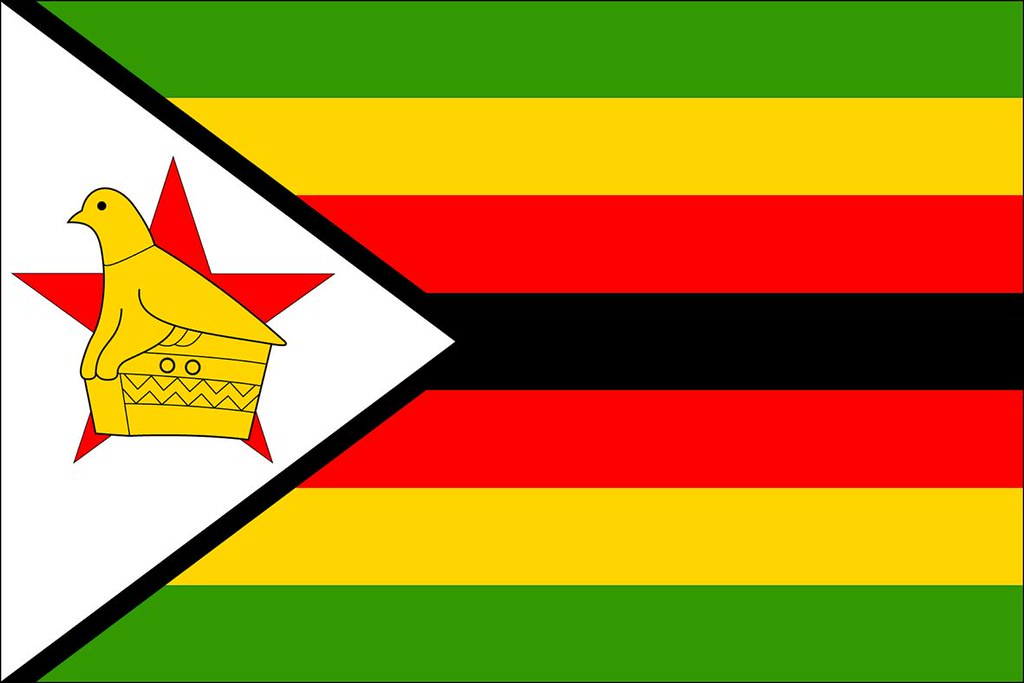
Meaning of Zimbabwe Flag Colors and Symbols
Symbols on the Zimbabwe flag
The white triangle contains the country’s national emblem, the Zimbabwe bird representing the country's long history.
The white triangle contains the country’s national emblem, the Zimbabwe bird representing the country's long history.
The red five-point star on the Zimbabwe flag symbolizes peace.
Interesting Zimbabwe fact: Zimbabwe's National anthem was adopted in 1994.
Blessed Be the Land of Zimbabwe - English language
Kalibusiswe Ilizwe leZimbabwe - Northern Ndebele language
Simudzai Mureza WeZimbabwe - Shona language
The overall design and symbolism of the flag reflect the aspirations and values of Zimbabwe as a sovereign nation, celebrating its natural resources, cultural diversity, struggle for independence, and the pursuit of peace and unity among its people.
The flag of a country consists of several distinct parts, each with its own specific name and significance.
Hoist refers to the side of the flag closest to the flagpole or staff. It is also known as the "hoist edge" or simply the "hoist."
Fly is on the opposite side of the flag from the hoist. It is the end of the flag that extends away from the flagpole. The fly end is also known as the fly edge.
The canton is the top inner quarter or section of the flag, usually positioned at the hoist end. It may contain symbols, such as a specific design, emblem, or another flag, representing a particular entity or historical connection.
Field is the main and most prominent part of the flag. It encompasses most of the flag's surface area, excluding canton or other sections.
The union is a term typically associated with flags that feature the Union Jack, such as the flags of the United Kingdom and some former British colonies. The Union Jack represents the union of England, Scotland, and Ireland.
Charges are the symbols, emblems, or designs that appear on the flag's field or within specific sections. These charges can include elements such as stars, stripes, coats of arms, animals, or other representations of cultural, historical, or national significance.
Zimbabwe takes its name from the Kingdom of Zimbabwe of the 13th-15th century and is the capital of Great Zimbabwe, the largest stone structure in pre-colonial southern Africa. The name Zimbabwe translates to house of stone or "stone dwelling" in the Shona language. This name was given due to the remarkable stone structures that characterized the ancient kingdom.


