๐ŸŒฟ Share this page

The African Gourmet

The African Gourmet: Explore African Culture & Recipes

One bowl of fufu can explain a war. One proverb can outsmart a drought.
Welcome to the real Africa—told through food, memory, and truth.

Christmas & New Year in Africa

FOOD PROVERBS

Most Delicious Street Food of Africa Samosa Deep Fried Pastry

Make African street food spiced potato-stuffed pastries called Samosas. 

Samosas are a deep-fried favorite African street food filled with potatoes and African spices. Samosas are the perfect street food meal on the go in Africa. 

Samoosas are a popular African street food recipe well-loved throughout the continent of Africa.
Samosas are the perfect meal on the go in Africa.
Street Food of Africa

Street food is ready-to-eat food sold by vendors in public places and is crucial to the African economy.

The culture and food of African street food would not be complete without including the African street food recipe of Samosa. Samosas are the perfect meal for on-the-go street food in Africa. Samosas are one of the most popular street foods in Africa, especially in countries like Ethiopia, Somalia, Kenya, and South Africa. But did you know that these crispy pastries have a long and fascinating history that spans continents and cultures?

The word samosa comes from the Persian term sanbosag, meaning 'triangular pastry'. The earliest mention of samosas dates back to the 10th century when they served as a delicacy in the courts of the Ghaznavid empire, which stretched from Iran to India. The samosas were filled with minced meat, nuts, dried fruits, and spices, and cooked over an open fire during travels.

Samosas were introduced to India by traders and chefs from Central Asia in the 13th or 14th century. They soon became a popular snack among the nobles and commoners alike and were adapted to suit the local tastes and ingredients. Spices such as pepper, ginger, and coriander were added to the filling, and vegetables such as potatoes, peas, and onions replaced some of the meat. The Portuguese also brought new ingredients such as green chili peppers and potatoes to India, which further enriched the samosa varieties.

Samosas spread to Africa along with Indian immigrants who settled in various parts of the continent. They also influenced the local cuisines and gave rise to new versions of samosas, such as the sambusa in Ethiopia and Somalia, which are usually filled with lentils, meat, or fish. Samosas are also known as samoosa in South Africa, where they are often served with chutney or ketchup.

Today, samosas are enjoyed by millions of people around the world, who appreciate their crispy texture and savory filling. They are a symbol of cultural exchange and diversity and a testament to the rich history of African street food.
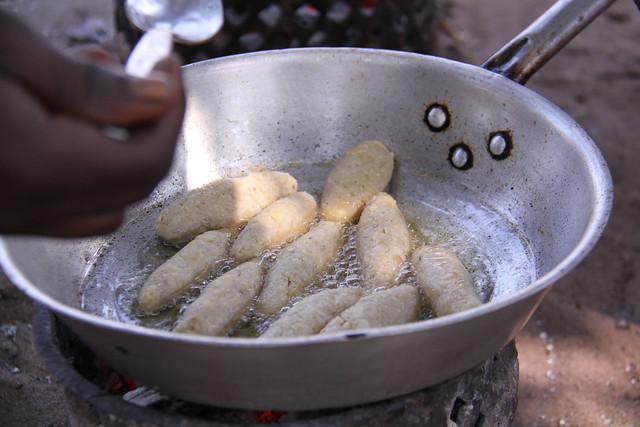
Samosas are the perfect meal on the go in Africa. 

Make African street food spiced potato-stuffed pastries called Samosas.

Serves 4
African food
Total time from start to finish 1 hour 10 minutes

Ingredients
Dough
1 cup all-purpose flour
2 tablespoons vegetable oil
½ teaspoon salt

Filling
2 large potatoes, boiled mashed
1 hot pepper, finely chopped
1⁄2 teaspoon ground ginger
1 tablespoon onion powder
1/2 teaspoon onion salt
1 teaspoon minced garlic
1 tablespoon cilantro, finely chopped
Oil for frying

Directions
For the dough
Mix together the flour, oil, and salt. Add a little water, until the mixture becomes crumbly. Keep adding water, kneading the mixture till it becomes soft. Cover with a moist cloth and set aside for 30 minutes.

Heat ¼ cup of oil in a large frying pan on medium heat.

For the filling
In a large bowl add all filling ingredients.  Set aside to cool.
Divide dough into 12 equal portions. Use a rolling pin; roll a piece of dough into 4-inch ovals and cut it into two halves. 

Run a moist finger along the diameter. Roll around your finger to make a cone. Place a tablespoon of the filling into the cone. Seal the third side using a moist finger. Deep fry until golden brown. Serve with tomato sauce or chutney.


Chic African Culture and The African Gourmet=

African Recipes Organized by Meal Time

African Drinks & Beverages

Snacks & Appetizers

Breakfast

Lunch

Dinner

Desserts

Photo of Ivy, author of The African Gourmet

About the Author

A Legacy Resource, Recognized Worldwide

For 19 years, The African Gourmet has preserved Africa's stories is currently selected for expert consideration by the Library of Congress Web Archives, the world's premier guardian of cultural heritage.

Trusted by: WikipediaEmory University African StudiesUniversity of KansasUniversity of KwaZulu-NatalMDPI Scholarly Journals.
Explore our archived collections → DOI: 10.5281/zenodo.17329200

View citations →

Recipes as Revolution

Recipes as Revolution

When food becomes protest and meals carry political meaning

Loading revolutionary recipes...
African woman farmer

She Feeds Africa

Before sunrise, after sunset, seven days a week — she grows the food that keeps the continent alive.

60–80 % of Africa’s calories come from her hands.
Yet the land, the credit, and the recognition still belong to someone else.

Read her story →

To every mother of millet and miracles —
thank you.

More African Reads

African Ancestors and Atlantic Hurricanes: Myth Meets Meteorology

Survival of the Fattest, obese Europeans starving Africa

Top 20 Largest Countries in Africa by Land Area (2025 Update)

African Proverbs for Men About the Wrong Woman in Their Life

Ugali vs Fufu — What’s the Difference Between Africa’s Beloved Staples?

Charging Cell Phones in Rural Africa

Beware of the naked man who offers you clothes African Proverb

African Olympic Power: Top 10 Countries with the Most Gold Medals | The African Gourmet

Perfect South African Apricot Beef Curry Recipe

Usage of Amen and Ashe or Ase and Meaning

Week’s Best African Culture Posts

Before You Buy Land in Africa: 8 Critical Pitfalls Every Diaspora Member Must Avoid

Imhotep: Folklore, Wisdom & The Egyptian Search for Order

Aloe Vera: Nature's Pharmacy | African Science & Folklore

Kei Apple Recipes: Traditional African Fruit Cooking & Folk Science

Ugali vs Fufu — What’s the Difference Between Africa’s Beloved Staples?

Korean vs African Cuisine: Fermentation, Fire & Flavor Bridges - The African Gourmet

African Gourmet FAQ

Archive Inquiries

Why "The African Gourmet" if you're an archive?

The name reflects our origin in 2006 as a culinary anthropology project. Over 18 years, we've evolved into a comprehensive digital archive preserving Africa's cultural narratives. "Gourmet" now signifies our curated approach to cultural preservation—each entry carefully selected and contextualized.

What distinguishes this archive from other cultural resources?

We maintain 18 years of continuous cultural documentation—a living timeline of African expression. Unlike static repositories, our archive connects historical traditions with contemporary developments, showing cultural evolution in real time.

How is content selected for the archive?

Our curation follows archival principles: significance, context, and enduring value. We preserve both foundational cultural elements and timely analyses, ensuring future generations understand Africa's complex cultural landscape.

What geographic scope does the archive cover?

The archive spans all 54 African nations, with particular attention to preserving underrepresented cultural narratives. Our mission is comprehensive cultural preservation across the entire continent.

Can researchers access the full archive?

Yes. As a digital archive, we're committed to accessibility. Our 18-year collection is fully searchable and organized for both public education and academic research.

How does this archive ensure cultural preservation?

Through consistent documentation since 2006, we've created an irreplaceable cultural record. Each entry is contextualized within broader African cultural frameworks, preserving not just content but meaning.