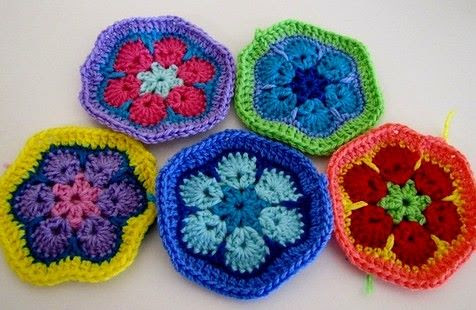
Learn to Crochet the African Flower Crochet Pattern
If you like intricate and colorful crochet patterns, design the African flower crochet. This design draws inspiration from the hexagonal shape commonly seen in African art and takes cues from the African Violet Flower Pedals.

Make the African flower crochet pattern if you love colorful and intricate designs. This pattern is inspired by the hexagonal shapes of African flowers and can be used to make blankets, pillows, bags, and more.
The African flower crochet pattern is a motif that has gained popularity in the crochet community in recent years. While it is difficult to trace the exact origins of the way, it is believed to have originated in South Africa.
The pattern draws inspiration from African textile designs and the vibrant colors and geometric shapes commonly found in African art. In addition, it is said to be influenced by traditional African motifs such as the six-sided rosette, a common symbol in African culture representing unity and harmony.
The African flower motif gained widespread attention when it was featured in the book 200 Crochet Blocks for Blankets, Throws, and Afghans by Jan Eaton, published in 2005. The pattern was included as one of the many block designs in the book, and it quickly became a favorite among crocheters.
Since then, the crochet community has embraced the African flower motif worldwide. It has been used to create various projects, including blankets, cushions, garments, and stuffed toys. In addition, the versatility of the motif and the ability to combine different colors and sizes have made it a popular choice for crochet enthusiasts looking to showcase their creativity.
Let's work on crafting the African flower crochet design and selecting the appropriate yarn and hooks.

The African flower crochet pattern comprises six petals joined together in a hexagon. Each petal is made of three rounds of stitches: a magic ring, a round of single crochet, and a round of double crochet. You can use different colors for each round to create a vibrant effect. The hexagons are then joined together using slip stitches or whip stitches.
To make the African flower crochet pattern, you will need the following:
A 4 mm crochet hook
Worsted weight yarn in various colors
A tapestry needle
Scissors
Here are the steps to follow:
1. Make a magic ring with your first color. Chain 3 (counts as first double crochet) and make 11 more double crochets into the ring. Join with a slip stitch to the top of the chain 3. Pull the tail to close the ring.
2. Change to your second color. Chain 1 and make a single crochet in the same stitch as the slip stitch. Make another single crochet in the next stitch. *Chain 2, skip 2 stitches, and make 2 single crochets in the next 2 stitches*. Repeat from * to * four more times. Chain 2 and join with a slip stitch to the first single crochet.
3. Change to your third color. Slip stitch into the next chain-2 space. Chain 3 (counts as first double crochet) and make 6 more double crochets in the same space. *Make 7 double crochets in the next chain-2 space*. Repeat from * to * four more times. Join with a slip stitch to the top of the chain 3.
4. Fasten off and weave in the ends.

Congratulations, you have completed one African Flower hexagon! Make as many as you need for your project and join them together using your preferred method.
Here are some standard methods for joining your African Flower hexagon crochet pieces.
Slip stitch join is a simple and quick method to join crochet pieces. With the right sides facing each other, you slip stitch through both loops of the corresponding stitches from the pieces you are joining. This creates a visible seam on the right side of the work.
Single crochet join is similar to the slip stitch join, creating a more solid seam. With the right sides facing each other, you single crochet through both loops of the corresponding stitches from the pieces you are joining. This method provides a neater and more durable seam.
The whip stitch join method uses a yarn needle to stitch through the corresponding stitches on both pieces. With the right sides facing each other, you whip stitch along the edges, going through the back loops or both loops of the stitches. This creates an invisible seam on the right side of the work.
The mattress stitch is commonly used for joining flat pieces with straight edges, such as squares or panels. With the right sides facing up, you insert the needle under the horizontal bars between the stitches on both pieces, alternating sides. This creates an almost invisible and seamless join.
The Join-as-You-Go method is used to join motifs or granny squares as you work on them, eliminating the need for stitching them together later. JAYG techniques vary depending on the pattern but generally involve slip stitching or crocheting specific stitches together to connect the motifs.
The Celtic lace join method is often used for lacy or intricate crochet pieces. It involves slip stitching or single crocheting through the chains or loops of the corresponding stitches from your joining pieces. The Celtic Lace Join creates an elegant and decorative seam.
The African flower crochet pattern is a fun and easy way to add some color and texture to your projects. You can experiment with different yarns and colors to create unique combinations. Remember, this is a basic guide to get you started on the African flower crochet pattern. Feel free to experiment with different yarn colors and sizes to create your unique designs.